A photograph from a public argument
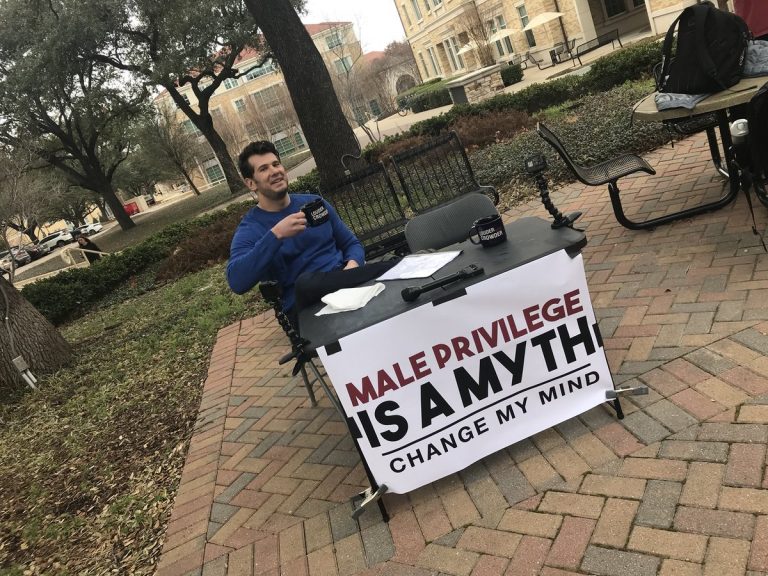
In February 2018, the conservative commentator Steven Crowder published a photograph taken at Texas Christian University. He sat at a table with the claim that male privilege is a myth, and invited opponents to change his mind. The scene was tied to his Change My Mind format: the host brought a disputed question into public space and talked with passersby.
That same month the photograph began to be remade on Twitter and Reddit. Some authors replaced the face, others edited the claim on the poster. The second technique became the lasting construction: the original political thesis gave way to anything at all, while the lower invitation to argue remained. The new statements belonged to the authors of the montages; the photograph supplied them with a stage and the confident pose of a person ready to defend his position.
Table, mug and empty chair
In the image Crowder, in a blue sweatshirt, sits at a dark table holding a mug. Papers lie in front of him, a microphone is nearby, and an empty chair has been left across from him. A large white poster is attached to the table with the original English claim and the line Change My Mind. Around are a brick path, trees, a fence and university buildings. The shot is slightly tilted, which strengthens the sense of an ordinary photograph taken at the scene of an event.
The empty chair makes the challenge concrete: a conversation partner seems to have been given a place already. The mug creates a calm, almost domestic tone, whereas the large letters are addressed to everyone passing by. In this version the text has not yet been replaced. The combination of everyday objects and a public statement explains why the later playful captions read like an opinion the author is ready to discuss as long as anyone likes.
An invitation that pretends to be a final verdict
The phrase “Change my mind” formally opens a conversation, but the meme often delivers it with deliberate certainty. The author declares a taste or habit to be an unquestionable truth, and then invites everyone else to labor at refuting it. The comedy appears in the gap between the triviality of the question and the carefully prepared stage for a serious debate.
This contrast is especially visible in arguments about food, games and household rules. A preference needs only a short personal remark, but the photograph turns it into a whole campaign: a table, a poster, a drink and an expected opponent. The host looks as if he will stay in his seat until final victory. This makes it possible to mock both the speaker’s stubbornness and the tendency of those around him to argue about any trifle.
The template keeps an open ending. The picture does not show the response of the person across the table, so the discussion can be continued by real participants in the chat. One defends the thesis, another sends a counterargument, a third makes a new poster. The invitation itself becomes the engine of the series, even when the original topic has long since faded away.
A public debate about private habits
In a fictional student chat, the poster carries the thesis “The first pair starts after the second cup of tea.” The author presents a personal feeling of alertness as the university timetable. A friend sends a photo of a clock: it keeps counting differently. The argument is funny because the table and the poster lend a drowsy excuse the status of a matter of principle.
Another montage is devoted to board games: “The person who reads the rules is already working as the host.” Behind this line lies a familiar situation, in which all the duties quietly fall to the most prepared participant. The invitation to change one’s mind provokes not a discussion of abstract fairness but a whole queue of stories about who dealt the cards and explained every move.
In a third variant, a cleaning enthusiast declares: “The box of cables is a family archive.” An opponent proposes throwing out a cable that nobody has found a use for. The author defends it as a historical document. Such a conflict gives the template a full little plot: one side inflates the value of an object, the other tries to bring it back to household scale, and a confident man with a mug seems ready to defend every forgotten connector.