Dante, Adam Ellis, and a new bottom tier
The literary basis is Inferno, the first part of Dante Alighieri’s Divine Comedy. On the hero’s journey with Virgil, punishments are distributed across the circles, and depth emphasizes the gravity of the transgression. This recognizable hierarchy gave the artist Adam Ellis a form for a personal complaint. In October 2015 he posted on Facebook a diagram with an additional place for people who claim others’ drawings and put their own watermarks on them.
Later the layout began to be reworked, keeping the upper part and replacing the author’s grievance. In 2018, variants appeared on Facebook and Reddit, including jokes about fan disputes and games. The specific resentment changed, but the structure remained the same: a familiar system of punishments unexpectedly continued with a personal item. This is a graphic meme inspired by Dante; its origin does not require reading the table as a screenshot from a computer game of the same name.
Nine captions and an empty space beneath them
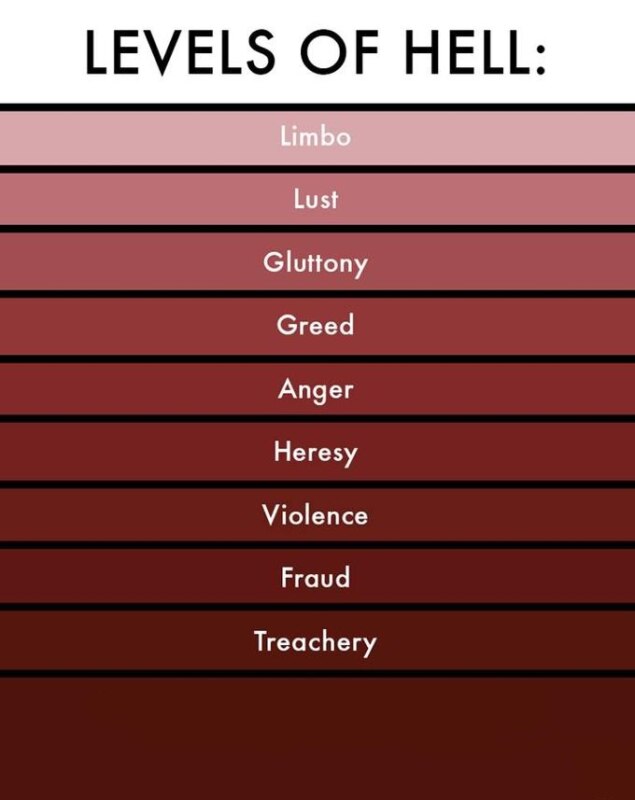
The upper white strip contains the heading LEVELS OF HELL. Below are pink and red rectangles separated by thick black lines; toward the bottom the shades become darker. In white letters are the labels Limbo, Lust, Gluttony, Greed, Anger, Heresy, Violence, Fraud, and Treachery: limbo, lust, gluttony, greed, anger, heresy, violence, fraud, and treachery. At the bottom is left a taller dark-red block without a caption.
The empty rectangle is the place for a future punchline, not a lost line of literary text. Its greater height visually highlights the final complaint even before it is read. The color transition sets a downward motion and strengthens the impression of consistent deterioration. The picture has no characters, fire, or depicted punishments: all the work is distributed among the order of the labels, the geometry of the table, and the new message the viewer expects to see at the very bottom.
A personal nuisance below treachery
The first nine lines create a serious expectation. They look like a finished cultural classification, which the author seems not to dispute. Then a domestic grievance receives a place even deeper than treachery. The disproportion is obvious, so the irritation becomes an exaggerated joke: the person is not merely displeased by someone else’s habit, but draws a separate floor of the cosmos for it. The dry table makes an emotional jab resemble an official amendment to a long-established system.
The format is especially convenient for small communities with shared irritants. The viewer does not need a long story about the violation: they already know why it is unpleasant, and recognize their own feeling in the excessive rating. At the same time, Ellis’s original version was tied to a specific problem of appropriating drawings. Later memes inherit the degree of outrage, but can direct it at quite different actions. The bottom line simultaneously reveals the plot and shows the personal value system of the one making the joke.
Three new lower floors
Invented example: “People who leave a single drop of milk and return the carton to the fridge.” At the bottom is an act small enough that the punishment looks absurd, and familiar enough that the reader immediately understands the grievance. A second variant: “Send a spoiler to the chat a minute before a group watch.” Here the group instantly recognizes a broken agreement.
The third scenario: “Rename the final file to final_really_last and ask for edits again.” The table turns the tedious finishing of work into an endless descent through the circles. The last block is funny not because of the cruelty of a punishment that is not shown at all, but because of the scale of the classification: an everyday annoyance has received its own line below all the heavy categories listed before it.