From cartoon series to meme format
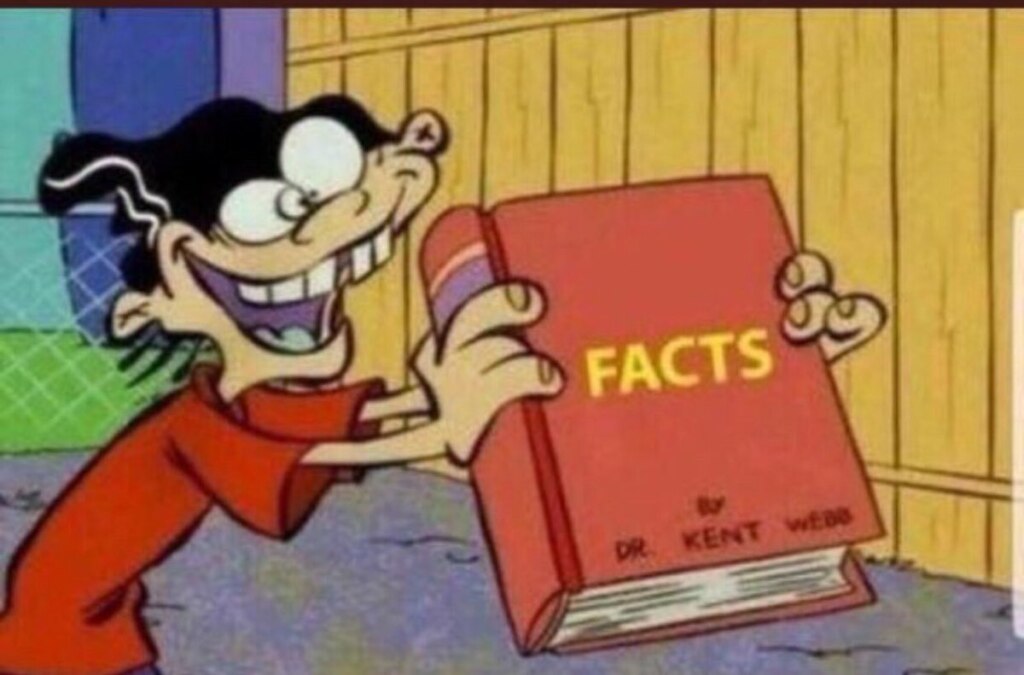
The red book appeared long before the internet template. In the episode “A Twist of Ed” of the series “Ed, Edd n Eddy,” Edd, who is also called Double D, shows the book to other characters. The episode aired on November 17, 2003. In the original drawing the book is devoted to psychology; the word FACTS on the cover is a later replacement, and along the edge a part of the name of Doctor Kent Webb is still visible.
In July 2017, Damarko Berry posted variants on Facebook with an altered cover and theses on the spread. Early examples included political satire; later the book was adapted to fan topics and everyday preferences. By August, remakes were already appearing on Reddit. Berry’s name is associated with the early versions, though the available records do not establish the point of the absolute first post. In this frame, Edd merely presents the closed book.
The cover lends an opinion the look of evidence
The word FACTS occupies the center of the red cover, and Edd’s smile promises the viewer persuasive content. The book becomes a prop for an authoritative delivery: the next text may be a verifiable claim, but it may just as well be a matter of taste or an exaggeration. What is funny is not that the meme exposes a particular thesis as false, but that wildly different content receives the same solemn frame.
Hence the wide range of tones. The political version can depict a confident debater who covers a dubious generalization with a loud cover. A caption about a favorite game uses the same pose more softly — as a playful declaration by a fan. The book does not change, but the price of the statement does: a contested formulation invites rebuttal, while a personal preference is usually read as self-irony.
The spread gives the thesis a comic payoff
In the common two-frame version, first the book is shown, then the open page with text. The second frame answers the promise of the first and makes the thesis itself the punchline. Invented example: on the cover, “FACTS ABOUT WORK CALLS”; inside, “in half of the cases a short email would have been enough.” The conclusion is recognizable, but it is the caption author’s observation, not established statistics.
Another invented example: “Facts about home coffee” gives way to the phrase “it’s especially good when you don’t have to leave the house.” Here the solemn form serves a small everyday pleasure. The spread works better when it contains one short thought: if it is explained at length, the viewer has time to weigh the argument and stops waiting for the comic twist.
What changes in the single-frame version
This frame has no page with an answer. Edd is only about to show the book, and the viewer mentally waits for a heading or proof. The caption can leave the anticipation open, for example: “Facts about why the family chat wakes up exactly before bedtime.” The book gives the line the tone of a confident announcement, although the content itself is not yet visible.
In the two-panel version the thesis is already presented and becomes the climax; in a single frame the comedy rests on the anticipation of the delivery. Adding the spread completes the story, while the closed cover leaves room for an imagined continuation. That is why this variant is especially expressive next to a punchline caption, and the open-page version works best next to a short thesis.