Meaning of the phrase
The expression is used when a person hands their mug to someone else and announces that they are about to do something risky. The point is self-confidence bordering on recklessness, and an outcome that is known in advance: in most stories the venture ends in failure. The closest Russian equivalent in meaning is “watch how it’s done,” but a literal translation keeps the beer context.
The phrase is usually taken ironically: the speaker understands they are acting rashly and points this out themselves. That is why it often appears in captions to videos where someone falls, breaks something, or picks a poor way to handle an everyday task.
Image
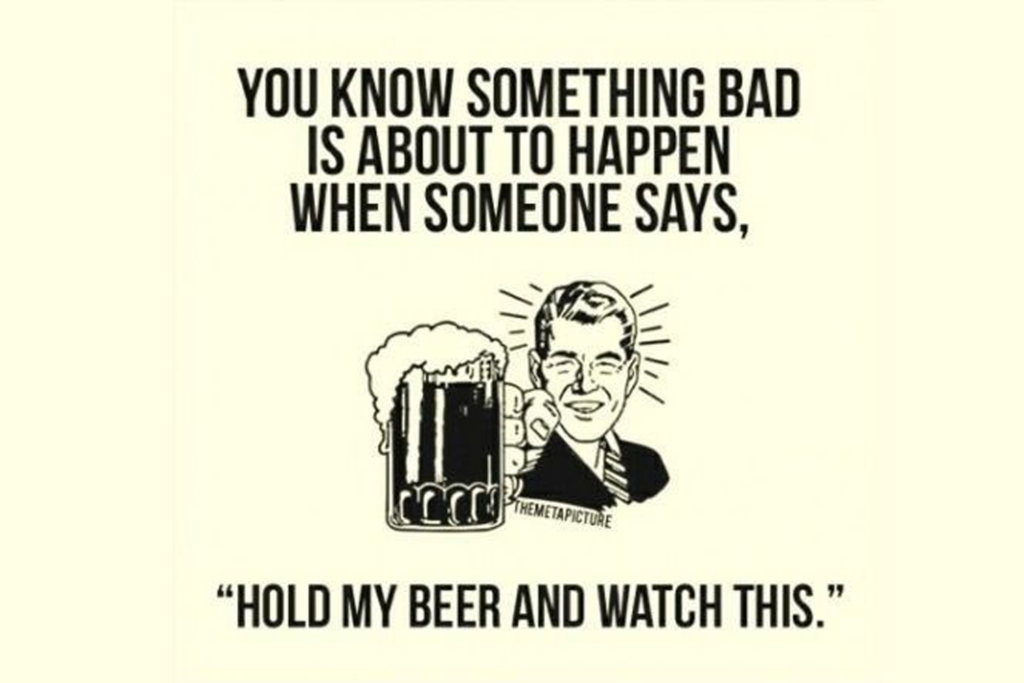
The submitted image matches the description: on a light background, large type reads “You know something bad is about to happen when someone says, ‘Hold my beer and watch this.’” Below the text is a man in a jacket holding a large mug of beer, drawn in a retro style. Under the mug, a small caption names the site that published this version.
The watermark refers to the source of the picture, not to the author of the phrase or the template. The picture is dated to 2006, but there is no confirmation that this particular picture was created or published in that year.
Origin of the phrase
The exact origin of the phrase has not been established. One review notes that the expression likely existed in spoken language long before the first written mentions, but it offers no evidence for this. The closest example in the material is the 1959 Warner Bros. cartoon “Wild and Woolly Hare,” in which a cowboy hands his beer to another character before a duel. The wording there differs from the modern one.
The modern version took hold later. Sources connect it with the performances of comedian Jeff Foxworthy, who in the late 1980s and early 1990s built a series of jokes, “You Might Be a Redneck If…,” about rural American culture. In his 1996 book “No Shirt, No Shoes… No Problem!” the line “Y’all watch this!” appears. According to the review, Foxworthy never said “hold my beer.” Who introduced the beer version is unknown.
Spread in the 1999–2010s
In print, the phrase first appeared in 1999 as a joke in the anthology “E-humor: An Anthology of Jokes from the End of the Twentieth Century.” In the 2000s it became part of a genre of clips in which people film dangerous stunts and add this formula to the captions. Such recordings spread on YouTube, and in the late 2000s and early 2010s communities labeled them “HMB.”
In 2016 and in April 2017, when several large companies publicly made PR mistakes, the phrase reappeared on X (formerly Twitter) as a parody of corporate blunders. Since then it has become one of the recognizable ways to describe a predictable failure, and a themed section on Reddit receives new posts almost daily.
Image template
The visual version is built on the scheme of a “familiar phrase”: the text at the top sets up the situation, the bottom line delivers the punchline, and the illustration adds character. A template like this is designed for quick recognition and is easily reused, so its text is often changed for new topics.
It is important to separate the phrase from its visual version. The phrase has a history that can be traced through printed and video sources. The picture is a separate template whose date of appearance is not established.