What's shown in the picture
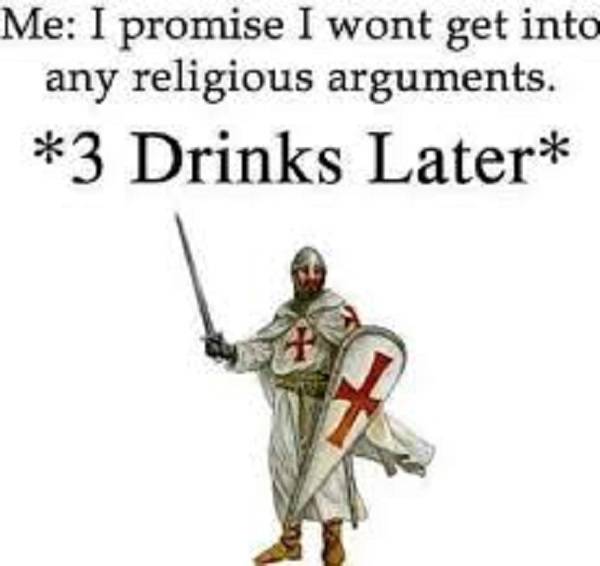
At the top of the image is a first-person line written in English: "I promise not to get into any religious arguments." The text is set in a plain, unadorned font, so attention is focused on the contrast between the words and the picture. Below it, in large text marked off with asterisks, is the note "3 drinks later." Beneath the text is a knight in a white cloak with red crosses, holding a sword and shield.
The figure is drawn in the style of a historical engraving or clip art, with flat colors and a simple line. The knight stands in a deliberately solemn pose, and this grandeur contrasts with the admission of being unable to keep from arguing. The visual gap between the solemn figure and the mundane confession is what creates the basis of the joke.
Origin of the format
The exact author and date of the first publication of the English-language template haven't been established from open sources. The format follows a simple pattern: first comes "I promise," then a note about the number of drinks consumed, and the promise is immediately broken. This device has long been used in humorous pictures and captions.
The image of the Templar knight belongs to a common category of medieval clip art frequently found in internet humor. The specific source of the image used in the template hasn't been identified, so the origin of this particular picture remains unclear.
In Russian-language communities, the format was often supplemented with its own notes and combined with other pictures, while keeping the general scheme: a promise, a note about timing, and an abrupt change of position.
The Russian adaptation
In the Russian-language version, the format got the name "Two shots later" and is often written as "Two shots later (after three shots)." The original note "3 Drinks Later" turned into a colloquial phrase immediately understandable to a Russian-speaking audience. The shift in the number of drinks doesn't change the meaning, but makes the caption shorter and punchier.
The template is most often used to describe how political or religious arguments arise over drinks at the table. For example, a person promises not to talk about an election, and after a couple of toasts is already arguing their position. The template transfers easily to any topic where a promise of restraint is doomed to fail.
The template is also often used in conversations about friendly get-togethers, where the promise not to argue is more a tradition than an actual intention.
Why the meme works
The main device is the gap between declaration and behavior. The viewer first sees a serious promise, then a short chronological note that flips the whole meaning on its head. This structure resembles a joke where the punchline arises from juxtaposing two phrases, so the meme reads instantly.
The humor is based on a recognizable experience: many people have noticed how, after a few drinks, mood and manner of arguing change. The knight with the sword adds hyperbole, because his warlike pose looks far too serious for a dinner table. In this way the meme turns an everyday situation into a comic image, without relying on mocking any specific group or belief.
The format also neatly illustrates an everyday paradox: sober, a person is willing to discuss controversial topics calmly, but after drinks emotion overrides reason.