What is shown in the picture
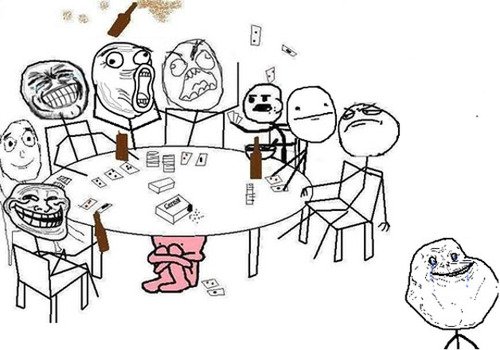
The image shows a scene at a card table, drawn in the manner of rage comics: the characters' bodies are schematic, with all the attention given to the faces. The players sit around a round table covered with chips, cards, and bottles. Almost every character here is a separate face — that is, a fixed type recognizable from other comics in the genre. Among them you can easily spot Trollface with its wide grin, which became one of the genre's main symbols, and Forever Alone, the lonely face in the bottom right corner of the frame.
The composition works like a collage of emotions. Gloating, rage, exhaustion, and alienation are all gathered in a single frame, and the character sitting apart from the group conveys the theme of loneliness. This device is typical of the genre: the artist doesn't tell a long story, but instead assembles a set of recognizable faces that the viewer reads instantly.
Origin
Rage comics appeared on the imageboard 4chan in 2008. The earliest amateur comics in the "FFFUUUU" style were posted on the /b/ board and consisted of short four-panel strips about everyday irritation. One of the first notable developments was the appearance of the character Rageguy, which emerged in August 2008 from a template created by an unknown author. Who exactly came up with the format itself hasn't been reliably established.
An important predecessor is considered to be Cereal Guy. This character was drawn in 2007 by Bob Averill for the SomethingAwful forum, and his face was often used as a reaction. In the fall of 2008, Trollface appeared, drawn in MS Paint by a deviantArt user going by Whynne. That's how a set of faces took shape, which then grew and became the foundation for the mass wave of comics that followed.
Rise and spread
In January 2009, the subreddit r/fffffffuuuuuuuuuuuu, known as f7u12, appeared on Reddit. Users submitted their own comics there, and many new characters were born on that platform. Among the earliest and most popular were Everything Went Better Than Expected and F*ck Yea, and in 2010 Me Gusta and Okay Guy appeared.
The genre quickly crossed over into mainstream culture. Y U NO Guy, a character from the manga Gantz, and Forever Alone turned into image-macro figures resembling advice-animal memes. In December 2011, Facebook released rage-face stickers for Messenger; in February 2012, the YouTube channel PistolShrimps launched the series "Rage Comics — In Real Life"; and in May 2012, Paul Boutin wrote an article for The New York Times about how drawing these comics helps relieve stress.
How the joke mechanism works
The main strength of rage comics lies in accessibility. No drawing skill is needed to make one: a simple program is enough, and on dedicated sites you could assemble a comic from ready-made faces. This turned every user into an author and quickly filled feeds with new variations.
The joke is built on the recognizability of the emotion. A wide grinning face means gloating, a twisted screaming face means rage, a lone figure in the corner means alienation. The viewer grasps the situation at a glance, and the recurring characters create a shared vocabulary that lets anyone quickly signal their state of mind in the comments.
The genre's fate
The genre's peak popularity came in 2011–2012. After that, rage faces moved into image macros and became reactions on forums and in messengers, and standalone comics stopped being the dominant format. No exact date for the genre's decline is recorded in sources, and the faces themselves still turn up as reactions.
In 2018, platforms in China restricted distribution of the Baozou Manhua brand after a video that joked about figures from the civil war. This case shows that, like other mass-market formats, rage comics carry a political dimension alongside their cultural one.