What the photo shows
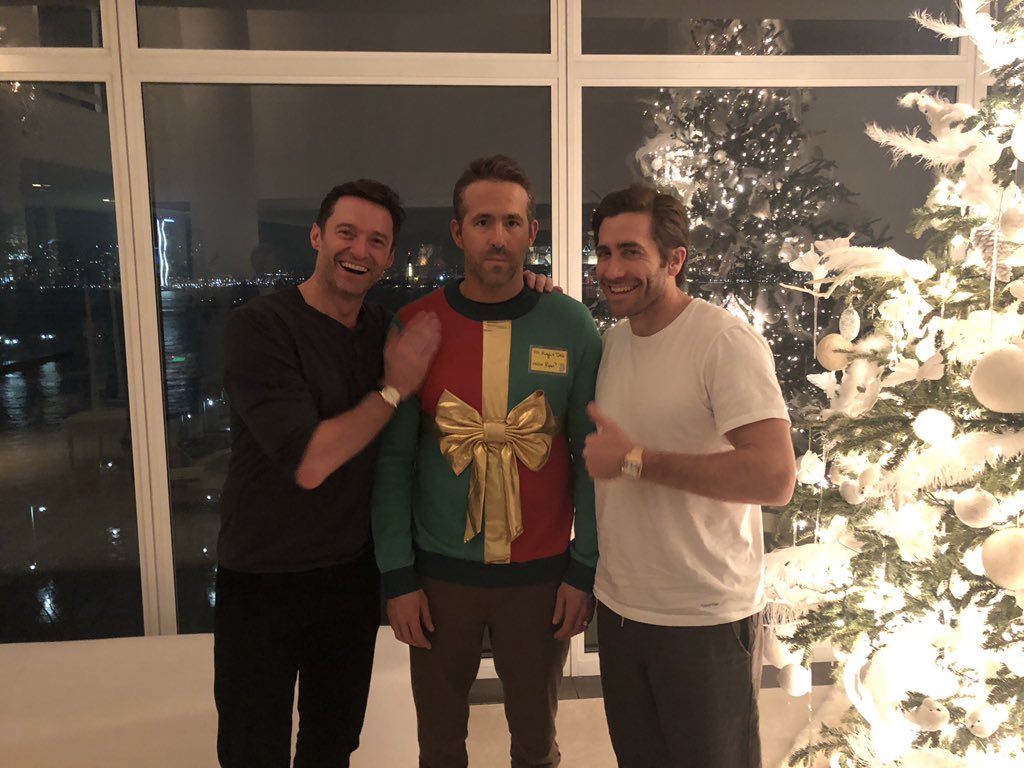
The photo shows three men standing by a large floor-to-ceiling window. Beyond the glass is a night city with lights and dark water, and to the right and behind them is a Christmas tree decorated with white balls and garlands. The identities of the people come from Reynolds’s own caption and from published reports about the photo: on the left is Hugh Jackman, in the center Ryan Reynolds, on the right Jake Gyllenhaal.
The central figure wears a sweater with red and green sections, with a gold vertical stripe running down the middle and a large gold bow, like on a gift wrapper. A small paper sticker with writing is attached to his chest. Jackman on the left, in dark clothing, is laughing and patting him on the chest, while Gyllenhaal on the right, in a white T-shirt, gives a thumbs-up. Reynolds himself looks calm and somewhat detached.
The 2018 prank
Reynolds posted the photo on social media on 20 December 2018. According to his account, his friends told him there was a party where everyone would wear festive sweaters, but when he arrived, it turned out that he was the only one in a sweater, while Jackman and Gyllenhaal were in ordinary clothes. The caption was playfully profane, and it was this tone that made the post popular.
The location of the shoot and the details of the evening are not disclosed in the published accounts, so there is no point in speculating about them. What matters is that the joke is built on a friendly ribbing in which the one who lost has the last laugh at his own expense.
Follow-up: the sweater and charity
The story continued in December 2019. Reynolds spoke about the prank in an animated video and announced a campaign in support of the SickKids children’s hospital in Toronto: he pledged to match whatever was raised by midnight on 24 December. Jackman joined the campaign too, wearing the same sweater in a new photo.
In this way the prank became an occasion for fundraising, and the sweater became a shared symbol passed from one participant to another. The amounts raised are reported differently, so it is not worth naming a final figure.
Examples of captions and how they work
Below are four invented captions; these are not quotes from the people pictured. “My friends said it was a sweater party. They didn’t say I’d be the only one in a sweater.” The joke works through a reversal of expectation: the viewer expects a shared celebration and gets a prank.
“When someone wrote ‘dress code: festive’ in the chat and I took it literally.” The word “festive” acquires a second meaning, and the laugh comes immediately, without a long explanation.
“They told me it was a gift. The gift is me.” The bow turns the person into the wrapping, and the last line delivers a precise conclusion, as if it explained the plot.
“Friends, I did ask you not to put me in the center of the frame.” The contrast between the request and what is visible in the photo gives a short irony without malice.
How to use this template
The frame suits situations where a person ends up in clothing or a setting they did not choose, and others see it and enjoy it. It is important to keep a good-natured tone: in the original story the participants laugh together, and the meme works precisely because nobody looks like a victim.
Captions about office parties, dress codes, presents and “thanks for the heads-up” work well. If a caption tries to make a specific person look foolish or humiliated, the joke stops being friendly, and such a version is better avoided. For captions it is handy to split the frame into three roles: the one who set things up, the one who got caught, and the one who is pleased with the result.