What is in the frame
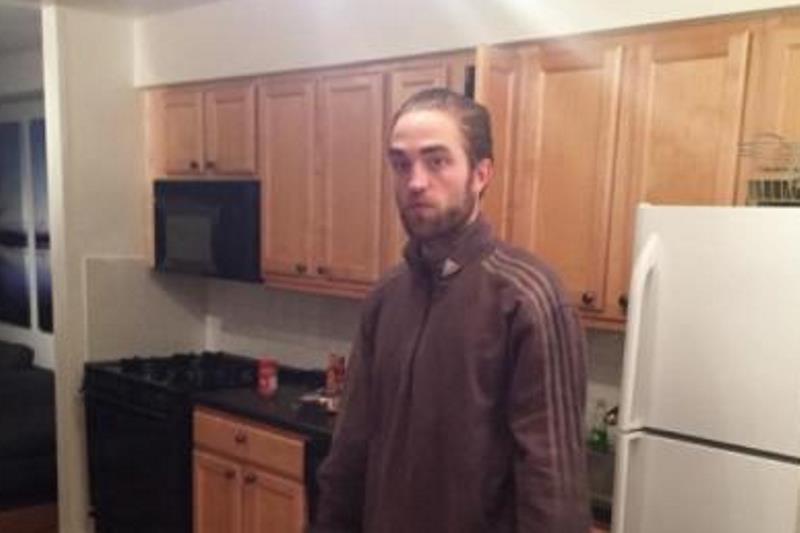
The photo was taken in an ordinary apartment kitchen. Behind the man are wooden wall cabinets, a black stove, a microwave on the wall, and a white refrigerator on the right. A jar and small objects are visible on the countertop. The man stands upright with his head slightly tilted, looking into the camera with mild curiosity. His hair is combed back, his beard is uneven, and he wears a dark brown tracksuit jacket with light stripes on the sleeve.
Nothing moves in the frame: the man simply stands there. That is exactly what makes the photo funny. He seems either a guest who does not know where to put himself, or a host caught off guard.
Where the photo comes from
The photograph was posted on Instagram on 9 August 2017 by director Josh Safdie, who captioned it as a "proto-Connie" from the film Good Time: that was his name for the earliest version of the hero's character, and the post went up on the eve of the film's American premiere. The frame shows Robert Pattinson, who plays the lead. So the photo is tied to the work on the role, not to the actor's private life, although online it is often taken for a casual everyday snapshot.
For a long time the photo stayed little noticed. It was posted to Twitter in November 2019, but its real burst of popularity came in August 2020, when two tweets with jokes about the "strange guy in the kitchen" each gained more than a hundred thousand likes. After that the picture became a reaction template.
Why the meme works
The photo has no single "funny" detail, and that is the secret. The contrast between an ordinary kitchen and a slightly strange, motionless pose creates the feeling that the viewer is looking at a moment from life where something has gone wrong, even though nothing is happening. The viewer invents the story.
Captions usually describe guests or relatives with odd habits, and the reaction is built on the exaggerated absurdity of the situation. The meme does not mock the actor himself: he simply serves as a form for the joke. Another device is to caption the picture from the point of view of the apartment's owner, who came home and found a stranger in the kitchen with a completely calm air. The character's calm in this case creates the comic effect: he clearly does not think anything strange is happening.
Caption examples
The template pairs well with jokes about "my acquaintance who came over." Invented examples follow.
"My boyfriend introduces me to his friend, who has been standing by the stove for an hour." The mild awkwardness of an introduction.
"My neighbor came by to borrow salt and stayed in the kitchen for another hour." The figure in the frame embodies such a guest perfectly.
"The person who arrives at the party first and doesn't know where to sit." A reaction to a situation familiar to many.
"Came to help with the move, and everything's already been moved." Confusion for no reason.
How to use it
The meme works best in comedic mini-scenarios and descriptions of awkward acquaintances. Do not make the caption too long: the simpler the situation, the stronger the effect. Do not attribute real actions or words to the actor, since the frame is used as a template, not as a story about a specific person.
If you come across the name "in a tracksuit," note that the frame shows only the jacket with stripes: the lower part of the outfit is not visible in the cropped version. For the joke this does not matter, but it helps avoid inventing extra details. A good option is to leave the kitchen background untouched: the cabinets, refrigerator and stove create the recognizable setting, without which the picture loses half its comedy.