What's actually shown
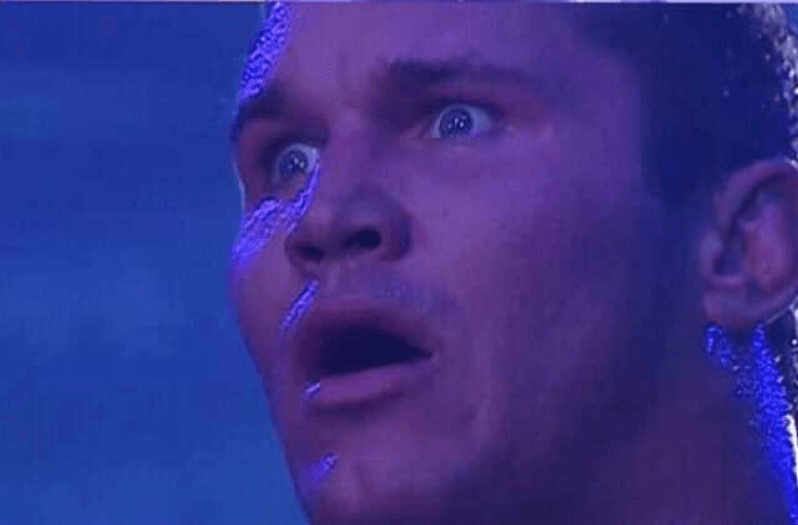
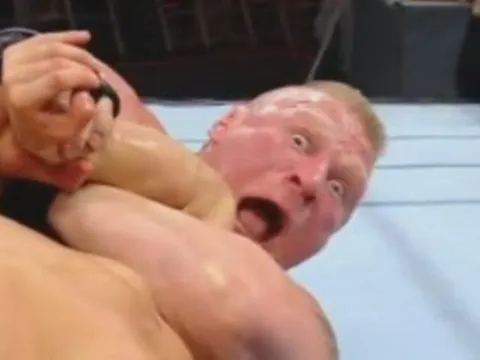
The image is a single frame, not two panels. It shows Randy Orton's face in close-up under cold blue lighting: eyebrows raised, eyes wide open and looking slightly aside and upward, mouth half open. Highlights and specks of light are visible on the skin, which makes the frame look like a low-quality TV picture. There is no fire, no smoke, and no Undertaker in this frame; his appearance is supplied by the captions.
This detail matters for those who make jokes: the picture itself shows only the viewer, while the spectacle stays off-frame. That is why the template is often used in pairs, with something that so amazed the hero added above.
Where the frame came from
Orton is an American professional wrestler who performs in WWE. According to descriptions of the meme, the frame dates to 2005: at the Survivor Series on November 27, the lights go out in the arena, a bell rings, and The Undertaker appears, whose entrance was famous for its gloomy theatricality. Orton is looking at what is happening with his mouth open. Sources differ on the details of the moment, so the exact scene remains unconfirmed.
As a template, the frame reportedly became popular around 2018: someone placed the Undertaker's entrance footage above Orton's face, and the result was a ready-made format of “look what appeared, and here's how people react to it.” Later the top part began to be replaced with anything at all. The expression in the frame reflects the moment it was shot, but does not prove what the wrestler himself felt, since this is also part of the stage show.
Why the joke works
The basis of the template is a gap in scale. The top part announces something grand: the return of a legend, the entrance of a star, a long-awaited release. The bottom part turns the event into a personal experience by showing the face of a person who is stunned. The viewer instantly understands that the event is truly big, and the one captioning it also admits to being shocked.
The joke relies on the sincerity of the reaction. Orton is not smirking or being ironic: he is utterly astonished. This lets the frame be used seriously, for example to express admiration, and in a comic way, when the reason for the shock is a trifle. The more trivial the cause, the stronger the contrast with the tragic expression.
Caption examples
The frame is also used without the top picture, in a single line: “Mom walks into the room when I reassembled all the furniture over the weekend” — the reaction says it all, and an ordinary household gesture looks like a divine apparition.
“Me when my favorite show is suddenly renewed for a fifth season” — genuine joy in the spirit of “no way.”
“The cat that saw a vacuum cleaner with a light for the first time” — shock transferred to an animal that can indeed look this way.
“Colleagues when I joined the call on time” — self-irony: a trivial event, a cosmic reaction.
How to use the template
The frame works best as the second half of a joke, when the first half is something impressive or unexpected. If you write a one-line caption, name the event directly so the reader does not have to guess what the hero is looking at. Do not caption the frame with words about fear or pain: it shows astonishment rather than terror. Do not attribute real statements or actions to Orton: here he is only the face of a reaction.
The blue tint and coarse graininess hold up well to compression, so the picture stays readable in small previews and chats.