What's shown
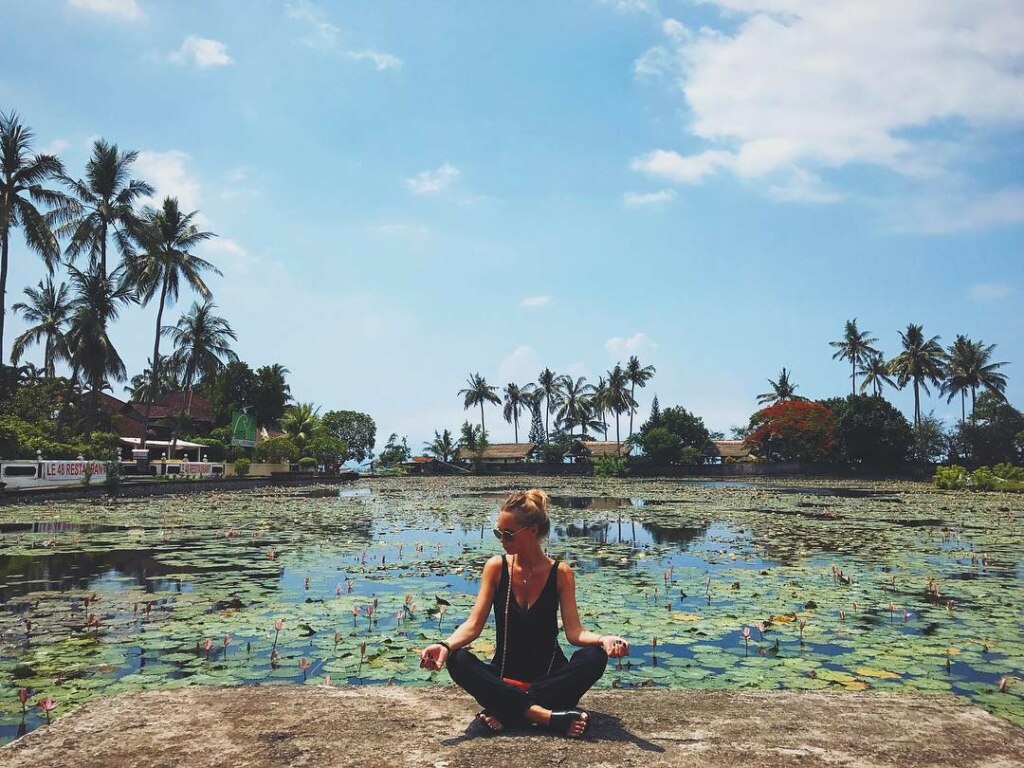
In the photo that became the basis of the meme, a young woman sits in lotus pose on a concrete ledge by a large pond almost entirely covered with water-lily leaves and flowers. In the distance are palm trees, low buildings with tiled roofs, and a restaurant sign. The sky is clear with a few scattered clouds — a typical picture for a vacation album or a travel-and-yoga page.
The photo's caption read like self-deprecating irony about a search for inner peace: meditation, relaxation, spa, and finally, "that's how I achieved zen." The hashtag #skazochnoebali was precisely the last word of that caption. The frame itself contains nothing lewd, and that's the meme's key feature: the whole joke rests on the text, not on the image.
History of its origin
The photo was published on Instagram on January 9, 2017. Already the next day, followers noticed the hashtag and began leaving hundreds of comments under the post explaining to the author that the phrase sounded suggestive. News of the "indecent" hashtag quickly spread across Russian news sites and later made it onto federal broadcasts, where it was discussed as the day's big story.
The author's reaction was lighthearted: she admitted the hashtag "hit hard," and didn't delete it. Users soon discovered that other women had used the same hashtag on photos from the island, turning the topic into a kind of collective game. The discussion continued on Twitter, where the hashtag was mentioned by a sports commentator who posted a vacation photo, and by bloggers who invited their followers to read the phrase themselves with the spaces removed. There's no confirmed data on who first wrote the hashtag exactly that way.
Mechanics of the joke
The meme's main resource is homonymy. The hashtag is written as one word, with no spaces or punctuation, so a reader can split it into words in two ways. The first option, "skazochnoye Bali" ("fabulous Bali"), matches the caption's meaning and the picture of the island. The second, "skazochno ebali" ("fabulously fucked"), uses a crude colloquial word and shifts the whole phrase's tone to something almost obscene. The brain reads familiar words in their usual order, so the second reading is often not noticed right away — but once it is, it can't be forgotten.
The joke gets extra force from the contrast between the calm meditation picture and the crude subtext. The more serene the photo, the funnier the accidental double meaning looks. Importantly, the meme doesn't mock the appearance or identity of the photo's author: the object of the joke is the hashtag itself and the habit of writing long captions with no spaces.
Use and spread
After January 2017, the phrase became a stable template for irony about tourist photos and about carelessly written hashtags. Users added it to photos of beaches and resorts, and sometimes to completely unrelated pictures, to produce the same effect of an awkward double reading. Over time, the phrase stopped being tied to a single post and turned into a generic name for any hashtag with a double meaning.
The meme is a good illustration of how internet humor worked in the early 2010s: a random caption, written without a second thought, becomes common property through the comments of thousands of people. The simplicity of the mechanism explains its longevity: understanding the joke needs no context, just knowledge of Russian and noticing the missing spaces.