The photo and its new life
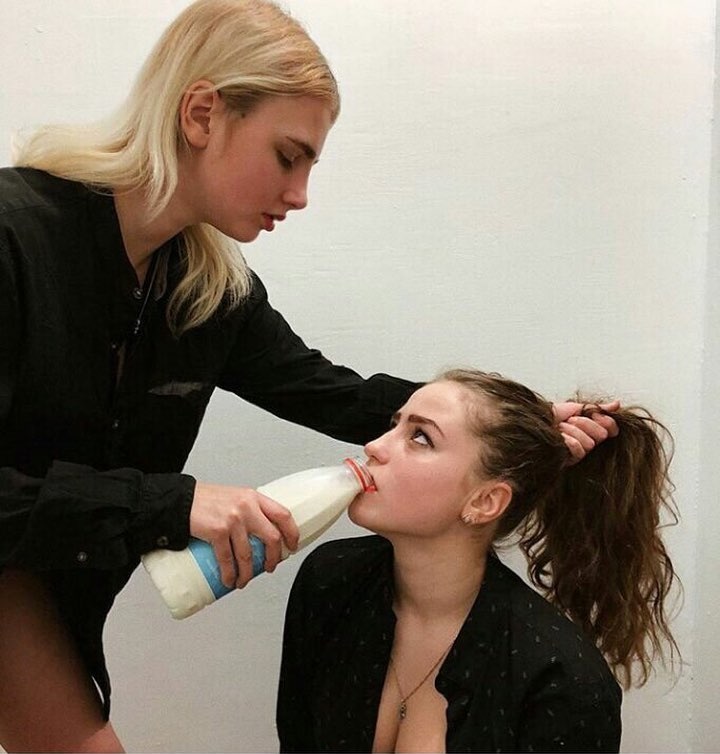
The history of the shot is linked to Russian photographer Evgeny Khramenkov and Instagram posts from December 2017. The image also appeared on the account of a participant under the name @soska_117. The photo existed before the meme captions: the original publication and the later joke about distributing roles are different stages of its life online. The external resemblance to a frame from a provocative video gave rise to guesses about its origin, but in itself it says nothing about the shoot.
One of the known early meme versions appeared on r/dankmemes on March 14, 2018, when user IMPER1AL compared the scene to an attempt to understand Stephen Hawking’s explanations. In the following months the image received other captions, and in summer 2018 it spread noticeably on Reddit. Among the remakes were imposed interests and even overly insistent gratitude. The latter case widens the meaning of the picture: pressure can be a comically exaggerated way of conveying an entirely friendly message.
Three places for three roles
In the photo, a blonde on the left leans toward a brunette on the right. With one hand she holds a bottle to the other’s mouth, with the other hand she holds the hair at the back of her head. Both are dressed in black, and the background is a light wall. The white bottle and its neck stand out between the faces. There are no ready-made captions, and the cropping focuses on the upper part of the scene, not fully showing the participants’ poses.
In the usual reading of the format, the girl on the left represents the one who insists, the bottle is the content, and the girl on the right is the recipient. The direction of transfer is visible from the neck at the mouth; the hand in the hair strengthens the sense of having no choice. This is the meaning of the gestures within the meme metaphor, not a story about the real participants’ relationship. Their expressions and poses become expressive elements to which new captions attach entirely unrelated situations.
When consumption becomes literal
Ordinary expressions such as “feeding someone promises” or “cramming information” become here a visible action. The viewer grasps the direction of pressure even before reading the text, and the caption on the bottle explains what exactly the imaginary hero is being overloaded with. Thanks to a separate object, one can name between people not only the sender and the recipient, but also what the conflict arises from.
The contrast between the intensity of the pose and the harmlessness of the content is often funny. A story about a favorite TV series is presented as if the listener won’t be let go until he has heard every season. Sometimes the author places himself on the left and admits his own pushiness; sometimes on the right, portraying fatigue from someone else’s enthusiasm. A third perspective is also possible: the source is an app or a study course, the recipient is a person’s attention. Then an interpersonal scene describes an overloaded environment without requiring a real quarrelling interlocutor.
Three invented streams of information
In the first example the captions are distributed like this: “a friend back from a trip,” “four hundred photos of one sunset,” “me, having asked how the vacation went.” The recipient started the conversation himself but did not expect such a volume of answer. The bottle makes the amount of impressions an almost physical burden.
Another variant places a study app on the left, with reminders about an unfinished workout on the bottle, and a person who came to read one message on the right. The joke arises from the persistence of a system that uses every free moment of attention. In the third example, the author offers his acquaintances his playlist and labels the bottle “my favorite track, once more.” Here he voluntarily takes the role of an overly enthusiastic sender. All three examples are invented; the content changes, while the object connecting the participants keeps a clear path from someone else’s enthusiasm to an overloaded recipient.