What is visible in the frame
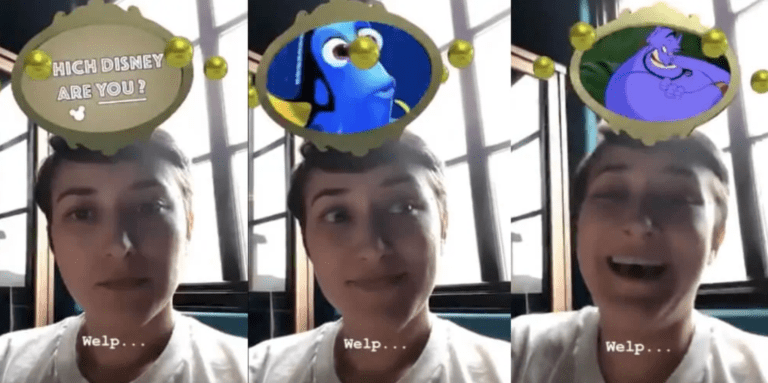
The image is assembled from three vertical screenshots. In each, a girl with a short haircut in a white T-shirt films a video on the front camera, and above her head hangs an oval golden medallion with four little balls. In the first frame the medallion reads “Which Disney are you?”; in the second is the blue fish Dory from “Finding Nemo”; and in the third is the purple-blue Genie from “Aladdin.” Under each frame is the subtitle “Welp...” — an English interjection, roughly “well, there it is” or “well, so be it.”
The facial expression changes: first a calm gaze, then a bewildered, slightly crooked smile, and in the last frame laughter. The girl's identity does not matter for the joke: she serves simply as the “face” of the reaction.
How the filter works
According to the meme's history, the “Which Disney Are You?” filter was released on December 27, 2019 by Instagram user arnopartissimo. It was preceded by a Spanish-language version, “Qué princesa de Disney eres?”, created before December 19, 2019. The filter randomly picks one of 25 Disney characters and shows its icon above the user's head. The set includes main characters, villains, and comic secondary characters such as the Genie and Dory.
Because the choice is random, no analysis of the face or character takes place, and this is an important part of the humor: the result says nothing about the person, yet everyone still treats it as a “diagnosis.” The filter became popular at the end of 2019 on Instagram and TikTok; well-known people also tried it, and major outlets wrote about the trend.
Why “Welp...” Is Funny
The meme rests on the gap between expectation and result. A person hopes to get Ariel or Elsa and instead gets a forgetful fish or a thousand-year-old spirit from a lamp. The “Welp...” reaction acknowledges this with humor. The third frame is especially effective: the person is not upset but laughing, that is, accepting the result.
A series of three frames creates rhythm: question, unexpected answer, reaction. This composition is convenient for captions where the heroine can be replaced by anyone who has run into an unexpected outcome: a test, a horoscope, an exam result.
The filter promises to “find out who you are,” and that is the trap: instead of a romantic heroine, you may get a comic character. A caption with “Welp...” accepts such a result with humor, and the viewer sees not disappointment but self-irony.
Examples of captions
“Personality test: you are an organized leader. My desk:” A contrast between the verdict and reality.
“The horoscope promised a lucky day. Coffee spilled, train gone. Welp...” The phrase sums up the gap.
“Everyone: I'm a princess! Me after the quiz:” A joke about random selection.
“I got the Genie, and I think it's the best option.” Here the reaction shifts to acceptance.
How to use the template
Three frames are easy to caption as a three-step story: expectation, result, reaction. If you change the caption, keep a short “Welp...” or its Russian equivalent: the point is self-irony. Do not caption the frames in an insulting way toward the girl in the picture: she is an ordinary user, not a character in the joke.
The format works well if the caption describes expectation and reality in two lines. The three frames already show the change of mood, so the text should not retell what is already visible.