A trend with no established author
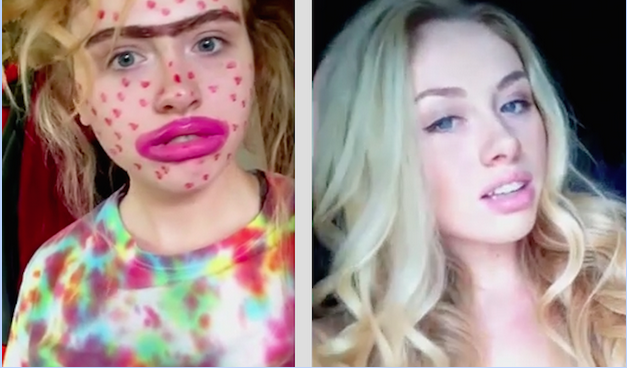
In July 2015, videos and photos with the hashtag #DontJudgeChallenge spread quickly across Instagram, Twitter and Vine. Participants painted freckles, a unibrow, fake acne or other exaggerated makeup on their faces, then removed it and showed a second look. Even at the time, the contemporary press could not establish who first came up with the hashtag, so the format cannot be credited to any one person.
In the same days, the video by blogger Em Ford, “You Look Disgusting,” was also widely discussed. That is a separate work: Ford read out comments about her skin and answered them with a call not to be ashamed of yourself. The video and the challenge developed side by side in time, but their structures differ: one relies on the contrast between two looks, the other on the comments and the reaction to them.
Two states of one selfie
In the first half of the pair you can see red dots on the forehead and cheeks, an emphasized line above the eyebrows, bright lips and a multicolored T-shirt. In the second, the same woman has her hair down and a calmer makeup look. This is a theatrical change of look designed for a short video: the face serves as part of the staging, not as evidence of any real skin condition.
A close-up and a similar angle make the change easy to notice right away. The viewer first reads the deliberately exaggerated details, then the finished makeup; the transition turns a simple pair of frames into a miniature transformation scene. The comparison works because of its convention, not because the second look is objectively better than the first.
The argument inside the word “don’t judge”
The title promises to reject superficial judgment, but moving from a grotesque look to a polished finish can keep the same scale: first the face is shown as a source of jokes, then the improved appearance becomes the reward. Contemporary coverage of the trend noted that many people saw a contradiction or hypocrisy in it. This is a debate about the form of the challenge, not a conclusion about each participant’s motives.
In this pair the transformation effect is made especially visible, so it clearly explains why the trend was both entertaining and criticized. Em Ford’s video is built differently: instead of makeup for the sake of contrast, it shows the real comments that hurt her and the author’s own response.
Invented captions
Invented caption: “Presentation draft after the editor’s corrections / version before sending.” Here the change of face works as a metaphor for the sharp difference between an overloaded first draft and a neat final version, without mocking the person in the photo.
Invented caption: “Before setting up the light for the video call / after finding a desk lamp.” The humor is built on the unexpectedly large effect of a small technical fix, not on any judgment of appearance.
Invented caption: “When the filter for the school play accidentally stayed on / when someone finally turned it off.” The imagined situation keeps the two-part edit but does not attribute to the participant a specific story or any problem with her skin.