The punchline in the last line
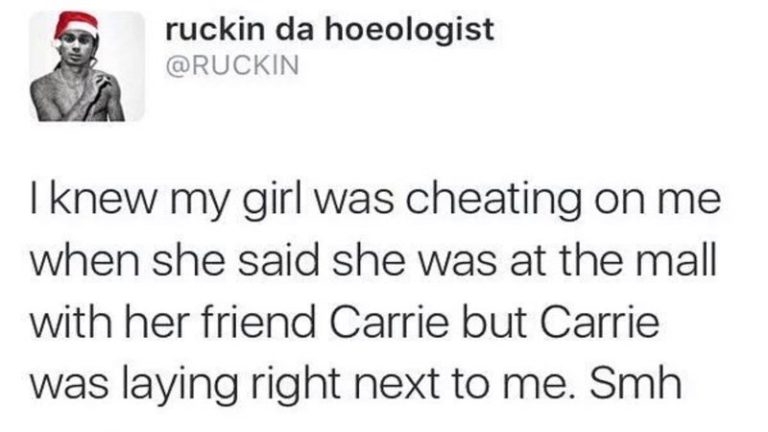
The screenshot shows a post from the account “ruckin da hoeologist,” @RUCKIN. The author writes that his girlfriend announced she was going to the mall with her friend Carrie, although Carrie was lying right next to him at that moment. The last line is “Smh.” The picture carries no photographer's name or date of the post; the image preserves the story but does not make it possible to verify whether such an episode actually happened.
Within the joke, Carrie's presence destroys the girlfriend's alibi. At the same time, the words “lying right next to him” can be taken as a hint at closeness between the narrator and her friend: then his indignation over her alleged infidelity sounds hypocritical. This is a reading of a comic text, not an established fact about the people behind the account. The short SMH ends the story before the narrator explains his own role, leaving the reader room for an uncomfortable counter-question.
An abbreviation from chat messages
SMH stands for “shaking my head” — literally “shaking my head.” One of the early dictionary traces of this meaning appeared on Urban Dictionary in February 2004; the entry records common usage but does not prove that the term was coined at that time. The abbreviation later became routine in text messages and online discussions. It is not a reaction with one exact shade: depending on context, it can express disappointment, disbelief, impatience or fatigue with obvious foolishness.
In Ruckin's post, the final placement matters more than the literal gesture. After a long contradiction, the reader already knows the reason for disbelief, and SMH compresses the judgment into three letters. If the ending were replaced with a full paragraph of indignation, the comic effect would weaken: the author would be explaining what the plot has already shown. Here brevity works as the narrator's last remark.
When three letters change the tone
The abbreviation can sound gentle, caustic or weary. It reproduces a gesture that is usually understood without words: a person shakes their head when what they have heard is hard to accept. But in written correspondence, the other person cannot see the face or movements, so three letters signal an attitude in place of an image or a long reply. How to read the gesture is suggested by the preceding message: a ridiculous mistake brings good-natured bewilderment, a repeated promise brings impatience, and an unpleasant act brings sharper condemnation.
The position of the abbreviation affects the rhythm. An opening “SMH, again...” announces irritation in advance, while a closing SMH lets the reader first take in the events and notice the mismatch on their own. This macro has neither a drawn head nor a series of frames: the last line plays the role of movement. This makes the image an example of a textual reaction, even though the story now circulates as a picture. When it is reposted, both the author's voice and the order of his unexpected confession are preserved.
Invented endings
An invented example: “Ordered a delivery to my home address, entered the office address, was surprised the courier was at the office” — SMH. Here the three letters sum up not someone's serious quarrel but an obvious mistake that the narrator notices too late.
Another invented version: “A colleague asked me to send a file that is already attached to the email” — smh. The abbreviation could also go at the start, but then it would announce the irritation in advance; at the end, it leaves the reader room to judge the oddity for themselves. In the original post, it is the final position that makes the abbreviation not a summary of the whole story but a brief closing gesture.