The charity video shrinks to a pencil
On February 16, 2018, Drake released the video for God’s Plan. Director Karena Evans tied the song to episodes of helping people in Miami: the rapper handed out money, paid for purchases, and took part in supporting the local community. At the start of the video it was stated that nearly a million dollars allocated to his budget had been given away. The public image of a generous benefactor became the central subject of discussion around the clip.
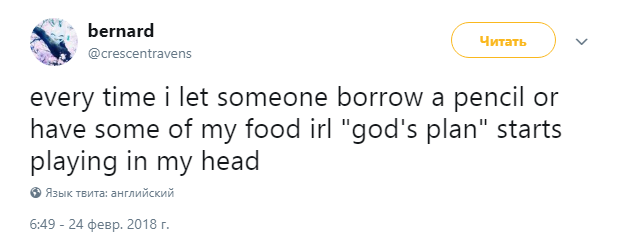
Very soon this scale was moved into short internet jokes. In a tweet from February 24, a user @crescentravens described how the song starts playing in his head whenever he gives someone a pencil or shares food. This is a well-known early example of the format: there is no need to film a musical scene; it is enough to describe a small act and mentally assign it a grandiose soundtrack.
By late February and early March, new variants appeared featuring small gifts, concessions, and pleasant coincidences. In them the song title worked as a director's stage note. The music seemed to switch on by itself as soon as the hero did something that could at least distantly be put beside Drake's generosity. The date of the clip explains the cultural reference, while the date of the tweet refers already to its parodic use.
A tweet about a small deed
The image is a screenshot of Twitter. At the top are the name bernard and the handle @crescentravens; below is English text about being willing to lend a pencil or share food. The closing part describes the song playing in the author's head. The post is dated February 24, 2018. There is no photo of the rapper or a scene of handing over money here.
The white card preserves the layout of an ordinary personal message. It is the mundanity of the design that makes the joke work: the narrator does not claim to have performed a great feat, but shows his own excessively solemn inner reaction. The music exists inside the description. Even without audio, the familiar title lets the reader imagine its arrival and grasp how far it exceeds the size of the deed.
A director of one’s own good deed
The format combines real small help with an inflated self-regard in the moment. Handing over a pencil is useful, but it is far from the generosity around which the music video is built. When the hero rewards himself with its soundtrack, he briefly turns into a famous philanthropist. Self-irony allows one to acknowledge a good action and at the same time laugh at the pleasure of one's own image.
The second variety uses luck instead of generosity. A difficulty resolves itself, the needed item turns up, or time unexpectedly frees up — and the song becomes a sign that the world is arranged favorably. Here the hero has given nothing away at all. The meaning shifts from magnanimity to a happy accident, which he experiences as a gift prepared specially for him.
In both cases the stage note compresses an entire emotional scene into the title of a track. The reader knows what scale of feeling is being proposed for an everyday event. The continuation can either support the triumph or quickly cancel it: the gift turned out to be very modest, the help required a ridiculous effort, and the hero had already managed to feel like a participant in a grand musical finale.
Small occasions for a loud soundtrack
In an imagined sketch, a person leaves a colleague the last clean spot on a shared shelf, moving his own mug a few centimeters. God’s Plan immediately starts playing in his head. Simple organization of space is presented as a self-sacrificing liberation of territory, although the sacrifice was almost unnoticeable.
Another example brings the solemnity into a board game. One player lets a teammate roll the die once more, because the teammate accidentally dropped it under the table. The imaginary song accompanies a small relaxation of the rules, and the generous player already sees himself as the company's chief patron. His inner scale and the real concession are deliberately out of step.
The third sketch is built on luck: an umbrella forgotten at home turns out to be unnecessary, since the rain stops just before departure. The hero has done no good deed at all, but assigns the event the same soundtrack. This variant keeps the feeling of a happy ending and changes its cause. The song’s title serves equally well for a small kindness and for a big relief from an ordinary coincidence.