The history of "Dog laughing" and known context
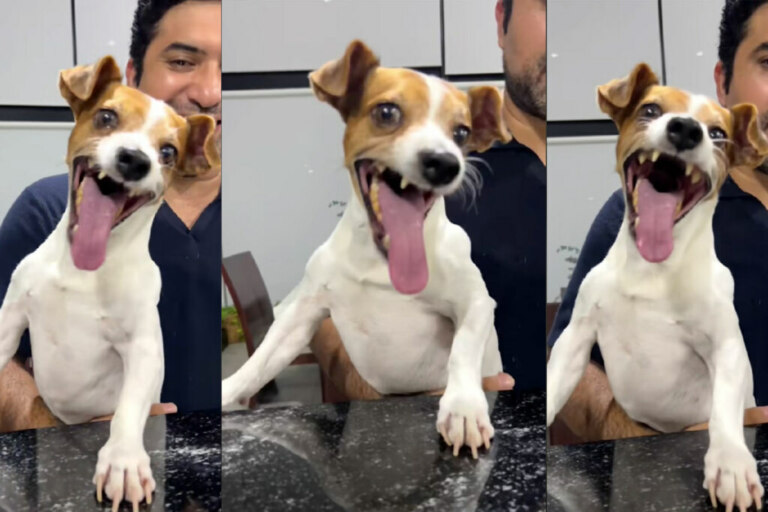
The three-panel collage preserves a single scene: a Jack Russell terrier sits on a table, opens its mouth, sticks out its tongue, while part of a person is visible behind it. What makes the template recognizable is the sound of a high-pitched human laugh laid over the video. The creator and the original filming location of the dog clip itself have not been reliably established. The sound has a separate, better-known history: it was used by TikToker Melly Own in a post on June 30, 2023; by late 2023, versions with the dog on a green background began circulating.
So the original dog video and the audio track have two different, not fully traceable histories. In reposts they're often merged, creating the impression that the dog is really laughing in a human voice. For the meme joke this doesn't matter, but editorially it's important not to attribute intent or a nonexistent line to the animal. The format is a classic reaction: a short facial expression and sound quickly get attached to a completely different scene.
Why "Dog laughing" works
The same laugh can sound like joy, a nervous chuckle, mockery, or a formal "uh-huh." The caption sets the meaning. If it describes a genuinely funny moment, the dog seems to be joining in the fun; if it's an awkward joke from a boss, the sound turns into a forced "ha-ha." It's precisely this ambiguity of the laugh that makes the reaction suitable for different social situations.
The three adjacent frames reinforce the impression that the laughter is building or repeating, even though it's really just editing of a single episode. The dog's cute appearance softens the jab; however, paired with a stern or bewildered reaction from another character, the joke can turn into mockery. One shouldn't confidently claim that this particular dog felt joy or was reacting to a joke: the well-known meme effect is created by editing and the added sound.
Original captions for "Dog laughing"
"Coworker: 'I sent the final version.' File: final_final_actually_last_v7." The dog laughs as a witness to the promise that didn't survive scrutiny.
"I'm politely laughing at the joke a relative is telling for the third time." Here the laugh sounds like a social ritual rather than real amusement.
"A friend said: 'I'll just lie down for five minutes' — and woke up two hours later." In this version the dog represents self-deprecating laughter at a familiar loss of track of time.
How to use "Dog laughing"
The template suits responses to awkward jokes, self-deprecating admissions, predictable failures, and moments that are funny precisely because of how absurd they are. It's best to keep the caption short and tied to a specific context; the sound already carries the emotional reaction. It's better used in a personal chat or a post where the audience already knows the video, so you don't have to explain the mechanics itself.
Be careful if the reaction targets a specific person: a laughing dog can turn a mild joke into public mockery. In work and study communities it's safer to aim it at a general situation or at yourself. The dog video's author and filming location are unknown, and unlike the sound, which has a specific source — Melly Own's post — the dog shouldn't be given a name or an invented backstory. A good caption explains the reason for the laugh in one phrase, doesn't retell the whole story, and lets the viewer hear for themselves whether the audio carries joy, nervousness, or polite pretense.