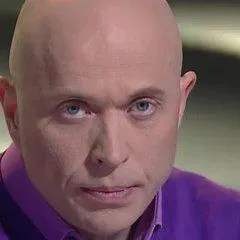
The reason for the July conflict
On July 5, 2018, Nikolai Sobolev released a video about Russia’s football match against Spain and the rapper Gnoiny. At the start of the video he praised Moscow’s Gorky Park and linked its development to the work of Mayor Sergei Sobyanin. Critics took this fragment as covert political promotion. The objection concerned the shift from familiar entertainment content to praise of city authorities.
Stas Vasilyev, performing under the name Max Power, made a critical video; other bloggers joined the discussion, including Morgenstern. The phrase about hypocrisy spread together with caricatures and remakes. In the July posts the community “Ovsyanka, sir” played a noticeable role. The story records the accusations and the dispute, but the popularity of the slogan itself does not confirm payment for a specific video or the terms of any alleged agreement.
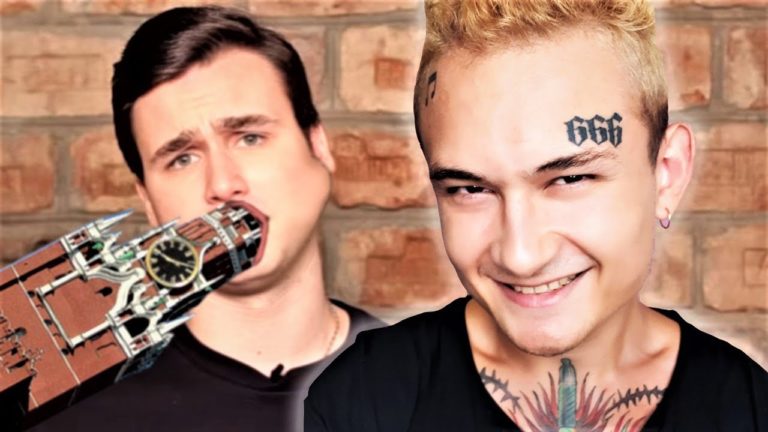
Two faces on a brick background
On the left is a dark-haired Sobolev with raised eyebrows and an open mouth. Into his mouth a montage inserts a tilted fragment of a building with a large clock. On the right Morgenstern smiles; his light hair, a 666 tattoo on his forehead and drawings on his neck are visible. Behind both of them is a brick wall. The collage has no separate text line.
The insertion breaks the scale and turns a photographic portrait into a caricature. Sobolev gets an alarmed, unstable expression, while Morgenstern looks pleased with what is happening. This arrangement does not show a real meeting or a joint shoot: the figures are combined in one composition for the sake of contrast. Even without a caption, the viewer sees whom the author of the montage assigned the role of the object of ridicule and whom the role of the winner of the dispute.
A slogan instead of a detailed argument
In this family of memes a name and a short judgment replace a long account of the conflict. For an audience that followed video bloggers, two words were enough to recall the video, the critics’ reaction and the comments that followed. Repetition turned the formula into a recognizable signal of belonging to one side of the discussion. In this way the meme became at once a joke, an accusation and a quote from an internet argument.
Critics compared the praise of Moscow’s authorities with the blogger’s earlier words. Retellings of the July conflict recalled Sobolev’s 2017 interview with Yuri Dud, in which he said he did not intend to get involved in politics. It is precisely the perceived gap between that position and the new video that explains the word “hypocrite” in the slogan. The collage emotionally strengthens the accusation, yet by itself it proves nothing about payment or behind-the-scenes arrangements.
Three invented contradictions
The first invented example: “The channel promised a week without ads and announced the promise with the support of an advertising partner.” The collage becomes a reaction to the mismatch between a solemn statement and the way it was presented. The second joke: “Me: I never argue in the comments. Also me: preparing the third part of my reply.” In it a public online spat turns into the self-irony of an ordinary user.
The third invented caption: “The reviewer called phones unnecessary, and in the next episode presented a collection of twelve.” It reproduces the mechanism of matching words and actions without making any new claims about Sobolev. In all three cases the faces play roles in an invented scene. The historical dispute remains the source of a recognizable format, while a specific contradiction gives the reader an independent reason to understand the ridicule.