What is visible in the photo
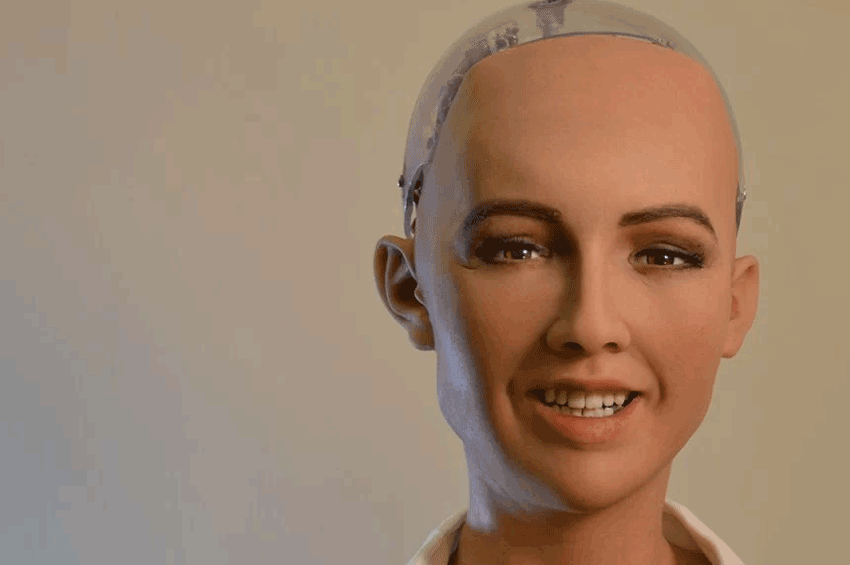
The shot is a close-up: the robot's head fills almost the entire right half of the image, and a warm beige-gray background stretches to the left. The top of the head is covered by a transparent cap through which elements of the internal structure are visible, and there is no hair. The face nevertheless looks almost human: smooth light skin, dark eyebrows, defined eyelashes, brown eyes.
The robot is smiling slightly, with upper and lower teeth visible. At the bottom of the frame the edge of a light collar can be made out. The contrast between the lively smile, the gaze into the camera and the transparent technical “cap” creates the picture's main effect: in front of the viewer is a machine trying to look friendly, and that is exactly why any menacing caption seems fitting.
The phrase that started it all
The line became famous from a demonstration shown in March 2016. The robot's creator, David Hanson, asked in a half-joking tone whether she wanted to destroy humans, and asked her to answer “no.” The robot replied: “Okay. I will destroy humans.” The recording spread through news and social media, and the exact view counts cited in different publications vary, so they are not given here.
It is important to remember that the phrase was prompted by a human question, and the answer was built from scripted rules of dialogue. Memes usually drop the question, and the words sound like an independent statement. The humor lies precisely in the mismatch: a polite, almost everyday intonation paired with a frightening meaning. The robot has no plan behind this, and using the picture to make claims about real danger would be inaccurate.
Who created Sophia
The robot was developed by the Hong Kong company Hanson Robotics, led by David Hanson. Sophia was activated in February 2016, and her first notable public appearances took place in the spring of that year. The project's main feature is facial expression: the face can change its expression, maintain eye contact and adapt to the interlocutor, so clips featuring her look more convincing than those with ordinary talking machines.
On October 25, 2017, at an investment forum in Riyadh, the robot was granted Saudi Arabian citizenship, which was officially announced. This became a separate reason for jokes: a machine with a passport, the rights and duties of a robot, and jokes that the “human destroyer” is now a legal resident of the country. The old line, however, did not go away and continued to live on as an ironic label for any robot with an unnaturally calm voice.
Why the frame works well for captions
The face in the photograph is neutral and slightly enigmatic: the smile can read as either friendly or sinister. Such a double meaning is convenient for a joke, because the caption itself chooses which of the two versions is correct. In addition, the robot looks straight into the camera, so it seems that the line is addressed personally to the viewer.
The template works in two modes. The first is a direct quote: “I will destroy humans” or a phrase close in meaning is added to the picture, and the funny part becomes the situation around it, for example, an innocent everyday request. The second is a transfer: the robot's words are assigned to a person whose minor problem is inflated to the scale of a cosmic threat.
Examples of captions and why they work
Below are three independently invented captions. All of them rest on one scheme: a serious formulation lands on an everyday occasion.
“Someone asked who will eat the last piece of pie. Okay. I will destroy the pie.” The joke is built on a shift of scale: a threat to humanity turns into plans for dessert, and the polite tone makes it even funnier.
“Asked not to open the group chat until morning. Opened it.” A short caption without extra words: the picture itself expresses calm determination, and the contrast between a minor transgression and a solemn gaze creates the comic effect.
“Promised to tidy up on the weekend. Okay. I will destroy the mess.” Here the robot's role goes to a person who takes on the cleaning: the grandeur of the task is out of proportion to its size, and the viewer easily recognizes the familiar situation.
How to use the frame
For a caption it is better to take a peaceful situation and a sharp reply, without referring to real people. The frame suits irony about fear of technology, but not claims that the robot is plotting something: it is a joke about perception, not a statement of fact.
A short formulation works well: one sentence with an unexpected answer. Long explanations usually kill the effect, because the viewer already understands what they are laughing at. If a second layer is needed, one can play on the appearance itself: the transparent cap instead of a hairstyle easily turns into a caption about an “energy-saving mode” or a “firmware update.”
Do not attribute to the robot other people's words from real news or real political statements. It is enough to keep her in the role of a polite and slightly frightening interlocutor, whose calm smile makes any line funnier.