Night, pillow, and phone
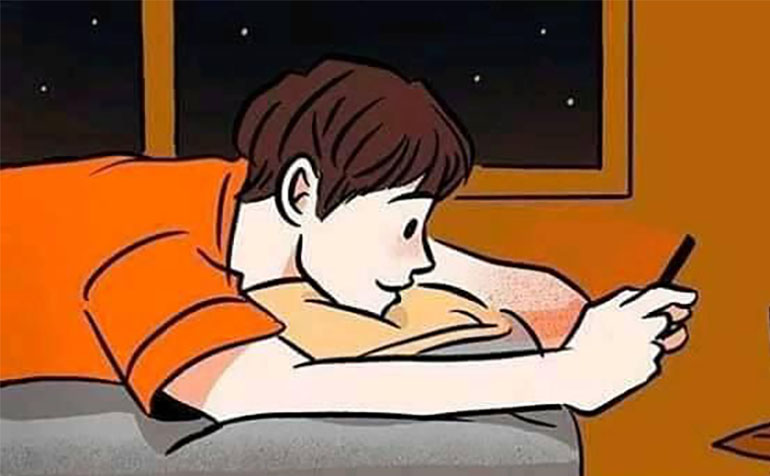
There's nothing in the illustration but the pose. A guy with dark chestnut hair lies on his stomach, hands tucked under the pillow, holding a phone in his right hand. His face is turned toward the screen, there's a blush on his cheeks, and a faint smile on his lips. Nearby is a window with a dark sky and white star-points, the whole room done in orange-brown tones, and the guy's clothes are orange too.
The screen itself isn't shown in the drawing, and that gap defines the meme: the viewer only sees a happy face and decides for themselves whether the phone holds a sweet message, a silly conversation, or the makings of drama.
A Reddit comic that became a pair of frames
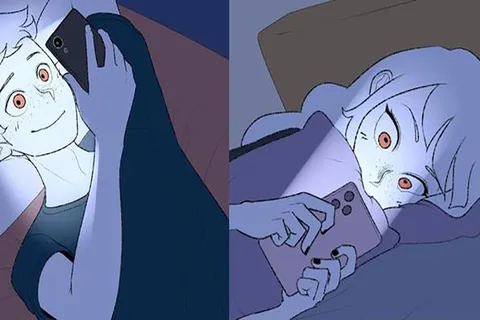
According to a meme encyclopedia's account, the source is a webcomic that user AlexMaestro posted on Reddit on May 12, 2021. In the original, two characters lie in bed with phones, texting each other; the pair is often called "the couple in bed with phones," or in English, "Boy and Girl Texting." The piece got tens of thousands of upvotes in its first few months.
The blocking version, according to the same sources, went viral in October 2021 and racked up hundreds of thousands of likes on Twitter. What survived is specifically the lone frame with the guy: there's no girl and no caption in it, as it's a cropped piece of a longer image. No earlier publications of this drawing have been found, so 2021 remains the date of the earliest known version, not proof of its very first appearance.
How the joke reads
The meme runs on a double move. First, the image promises tenderness: night, stars, a smile. Then the caption breaks the expectation and shows that the relationship is ending just as fast as it began, hence the phrasing about unfriending and blocking.
It works because it describes a final break, with no arguments or explanations, in a single phrase. The irony is that the most romantic-looking image announces the coldest possible reaction.
Four caption scenarios
First idea: "Me, when the other person wrote: let's meet up sometime." The guy smiles, right up until he realizes that "sometime" means "never." The contrast between the joy and the subtext is the joke.
Second: "Reading a message offering to sign up for a newsletter because I 'won a prize.'" The character lies there, pleased, and then deletes the contact; the comedy is in the mundane scale.
Third: "Him: I have a girlfriend. Me: okay, but keep texting." The caption uses the frame as a portrait of someone talking himself into something.
Fourth: "Group chat with classmates after someone asks: who still hasn't paid up?" The scenario shows group tension while the image stays romantic, so the gap with reality stands out.
Things to consider when using it
The frame suits stories about texting, late-night messages, and expectations about other people well. It works worse without context: on its own the picture just reads as "a guy smiling at his phone," so the caption needs to be specific.
Avoid using the drawing in jokes that mock a real, named person: it's an illustration, and the character should stay a generic stand-in.
It's also worth remembering its shape: the image is wide and warm-toned, so it reads instantly in messengers and stories. For a sadder tone, set the caption at night or after a workday; for an ironic one, keep the text under one sentence. The same drawing switches surprisingly easily between a tender and a harsh reading, and that's exactly why it gets used so often.