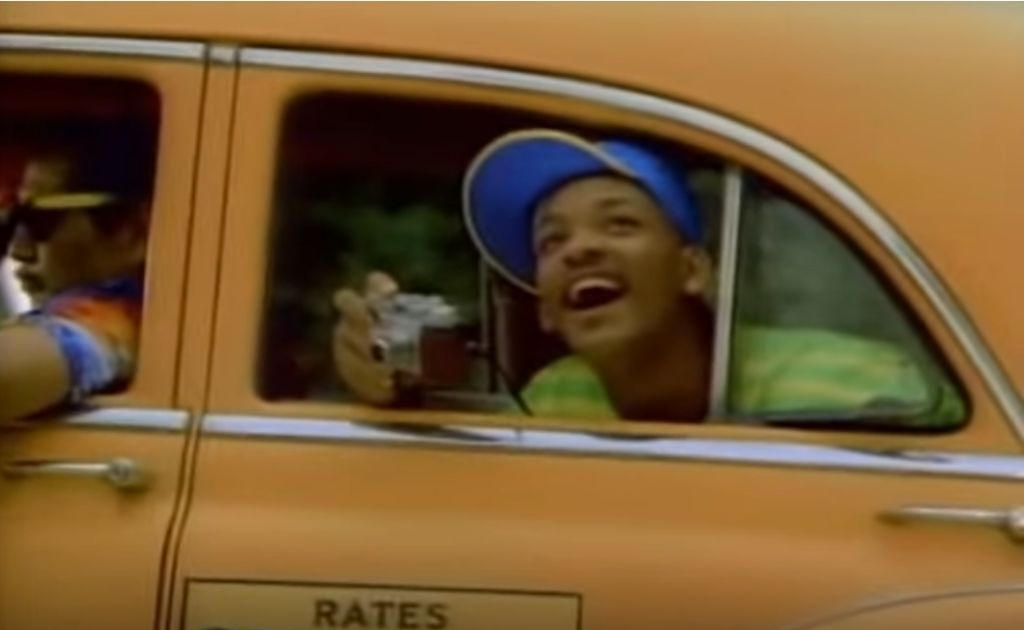
A passenger with a camera in a taxi
In the shot, Will Smith is in the back seat of a taxi: he's looking out the window, camera in hand, ready to shoot whatever passes by. His face is interested, with no trace of fatigue — this is what someone looks like who has just found themselves in an unfamiliar city.
Even without the opening-credits context, the shot needs no explanation of a move. The camera, the gaze out the window, and the interested expression give enough information on their own. A viewer may not remember the show, but will still recognize the familiar situation: there is so much new around that you want to preserve every little detail.
The Fresh Prince of Bel-Air opening and the move to Los Angeles
The image is tied to the opening credits of the sitcom The Fresh Prince of Bel-Air. Will Smith plays a young man who moves from Philadelphia to live with wealthy relatives in Los Angeles. The taxi ride closes out the story of his arrival into a new life. That's why the character's amazement has a literal plot meaning: he's looking at the place where he's about to have to settle in.
The show aired from 1990 to 1996, and captioned versions of the shot appeared on social media many years after it ended: the image spread through Twitter, then Tumblr and Reddit. Later, the photographing passenger was used as a short reaction, understandable even without knowing the show.
Why a newcomer's naive joy is funny
The easiest way to read this template is as a meeting between big expectations and the most ordinary scenery. For a local, what's in front of them is just a familiar yard or intersection; for a newcomer, it's already a sight worth seeing. The caption changes the scale of the event, while the character keeps reacting with the same enthusiasm. That's exactly why the same pose works both for a commute to work and for a city tour where nothing special is happening.
There's also another possible shade of meaning: the person doesn't yet know what's coming. The shot then becomes the first act of a story the viewer finishes in their head. For instance, the happy journey to a new job can be contrasted with a future encounter with work chats. A joke like that doesn't need a second shot: it's enough to name the reason for premature optimism. The viewer fills in the rest themselves, which is why the template transfers easily to any situation where someone is too happy about something just beginning.
First day at work and fourteen chats: sample captions
"On my way to the new office, haven't been added to the fourteen chats yet." Here the cheerful passenger shows anticipation, while the short addition hints at the daily routine to come.
"A friend is showing me around their neighborhood. I'm already photographing the third bakery." The joke rests on the gap between one person's routine route and another's full-blown sightseeing tour.
"Heading out of town for one day, planning on two weeks' worth of impressions." This caption suits a story about a short trip and conveys sincere, slightly exaggerated enthusiasm.
These captions were made up for this article. In the first, the optimism is clouded by future work troubles; in the second, the trip turns into a tour; and the third conveys joy with no catch. The same shot carries different tones: the expectation of disappointment comes from the text, not necessarily from the look on Smith's face.