What the picture shows
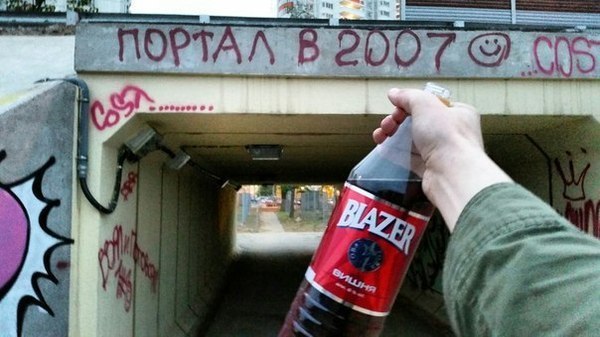
The photo shows a pedestrian underpass with light-colored walls, on which graffiti spells out "PORTAL TO 2007" with a drawn smiley face. Other scrawled signatures and tags are visible nearby, and in the right part of the frame a hand holds a plastic bottle of the drink Blazer. Further down the corridor is an exit, beyond which a courtyard with trees and houses can be seen.
The composition plays on the idea of a passage: the underground corridor becomes a metaphor for a portal you could use to go back to the past. The writing itself also sounds like a promise, since "portal to 2007" offers a way into a bygone time. The bottle in hand adds a down-to-earth, youthful atmosphere that many people of that era remember from their own apartment-building entrances, courtyards, and hangouts.
Where the phrase came from
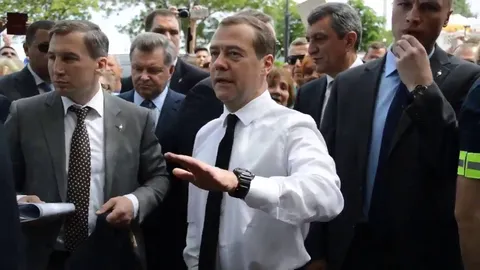
According to press reports, the phrase is tied to a remark by Dmitry Medvedev: in 2011, speaking with journalists, he said that "no one will ever return to 2007." The president's words were taken as an ironic admission that time moves relentlessly forward, and they quickly became a pretext for retorts online. Soon enough the formula "give me back my 2007" itself began spreading across communities and blogs.
According to one version, a VKontakte community called "Give Me Back My 2007" appeared in 2012, and the phrase's authorship was attributed to blogger Vitaly Kostilin, who had himself once been part of the emo scene. The community is still active today, and its existence helped cement the formula as a lasting meme. However, the origin hasn't been firmly established: the details of its first use and authorship remain a matter of assumption, and sources disagree on the specifics.
What the year 2007 meant
For those who were 13 to 18 years old in 2007, it was a time of first serious passions: the music of that period, teen communities, LiveJournal blogs, first relationships, moves, and high-school graduations. The emo subculture was then highly visible in clothing, hairstyles, and music, and many remember the lifestyle of that time as especially emotional and open.
The nostalgia here is collective in nature. The meme unites people who spent that year differently but share the sense that life was simpler back then. The press often also recalls the economic backdrop: the dollar exchange rate was noticeably lower then, and the future seemed more predictable. So the phrase sounds not only like a memory of the music, but also like regret for a stability that no longer exists.
How the meme is used
The phrase turns up in posts, captions, and comments, often alongside childhood photos, old posts, and shots from the emo era. The typical formula is "give me back my 2007," sometimes with "portal to 2007" added, or the name of a song that was playing everywhere back then. The meaning of the statement is almost always the same: the author wants to go back to their youth.
The meme periodically resurfaces. Waves of interest hit in the 2010s and the 2020s, and in the fall of 2026 social-media users, including on Instagram, actively picked up the trend again, often set to the song "September" by the band Stigmata, released in 2007. This kind of cycle is typical of nostalgic memes that new generations rediscover.
Why the meme endures
Nostalgia for one's own youth is universal, so the meme passes easily from one generation to the next. The phrase is short, recognizable, and needs no explanation: naming the year alone is enough to conjure, for the reader, the image of a bygone time.
There's also an ironic layer. The formula easily turns into self-deprecation: the author admits their memories are naive, but still wants them back. The "Portal to 2007" graffiti amplifies the effect, since the joke is both funny and touching at once, much like nostalgia itself.