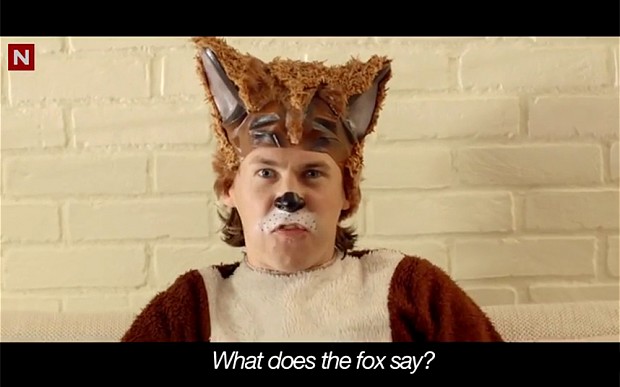
A frame from the video
The frame shows a person in a fox-head mask and a brown fur suit looking straight into the camera against a white brick wall. The nose is dark, and around it is a light patch that makes the image almost theatrical. At the bottom is the subtitle “What does the fox say?”, and in the upper left corner is the logo of a TV channel.
The video is shot seriously: the hero's face is deadpan and the setting is deliberately plain. This contrast is what makes the frame recognizable even outside the clip.
How the song came about
The authors of the song are the brothers Vegard and Bård Ylvisåker from Bergen, known as the duo Ylvis. The video was released on September 3, 2013 and was made for their TV show. The song was produced by Stargate and M4SONIC, and the clip was directed by Ole Martin Hafsmo.
The idea was to parody dance-pop hits. The track was conceived as a comedic “anti-hit,” and its success outside Norway came as a surprise to the authors.
How the wave spread
The clip quickly spread through the English-speaking internet and got into major media. It gathered 100 million views in 35 days, faster than “Gangnam Style,” which needed 51 days. By November 2025 the video had more than 1.1 billion views, but the exact figure changes over time.
In Norway the song topped the national chart for four weeks in a row. In the US the single debuted at No. 29 on the Billboard Hot 100 and then climbed to No. 6, where it stayed for three weeks.
Why the question works as a joke
The phrase is built on a mismatch. The form of a pop song promises a meaningful answer, but the chorus delivers a set of meaningless sounds. The more confidently the question is asked, the funnier the answer looks, and this is the main mechanism of the whole joke.
That is why the phrase often serves as a frame: it is placed where an exact answer is expected, and an absurd one is delivered. The question is in English and is easily recognized, so the caption needs no explanation.
Examples of captions
“What does the fox say? — I asked a colleague why everyone leaves early on Fridays. He answered: ‘yip.’” The question from the clip sets a serious tone, and the answer turns the conversation into absurdity. The unexpected simplicity of the answer does the work.
“What does the fox say? — I looked at my card balance and realized the foxes got to the bank today.” The situation is real, and the answer is fairy-tale-like. The contrast between an everyday problem and an animal answer creates the comic effect.
“What does the fox say? — The wardrobe instructions say: ‘yap.’” The joke targets the instructions: the reader expects a concrete step and gets a sound instead.
“What does the fox say? — I said ‘no’ at the meeting, and the whole department repeated it in unison.” The phrase becomes part of a collective joke. The rhythm matters: question, pause, answer.
How to use the frame
The frame works best for situations where someone is waiting for an answer and gets nothing meaningful: an unclear message, a strange reason, a vague excuse. The serious face in the fox mask becomes a mirror of the bewildered interlocutor.
The caption should be short: the question is already in the frame, so the text should provide only the answer or the situation. Extra explanations break the pause on which the effect depends.