How the picture is built
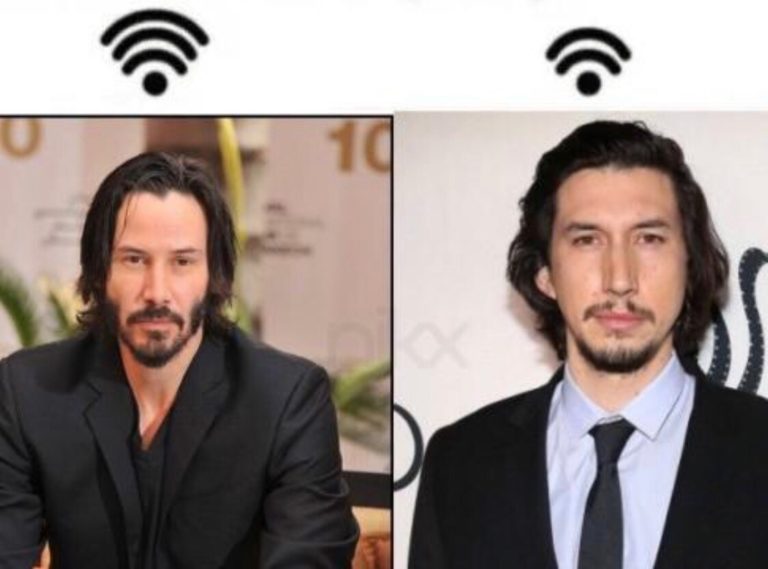
The image is divided by a vertical line into two parts. Above each part is a Wi-Fi icon. On the left the icon is full: a dot and three arcs. On the right there is one arc fewer, so a dot and two arcs remain, as with a weak connection.
Below the icons are portrait photos of two men. Both look into the camera, and both have dark shoulder-length hair and a small goatee. On the left is a man in a black jacket against a light background with plants; his beard is thicker. On the right is a man in a dark suit, a light blue shirt, and a dark tie; his goatee is neater and thinner. The main idea is visible at once: the people are clearly similar in type, and the differences seem like a small “drop in signal.”
What is known about the origin
The origin of this template is not established: no reliable information has been found about who first compared two photos this way, or when. It is only known that the device of “original and its weak copy” has long been used online, and the familiar signal-strength icon fits well for indicating quality.
The identities of the people in the photos are not given in the picture itself, and it is not worth relying on guesses. For analyzing the joke they are not needed: it is enough that the viewer sees two people similar in appearance, one of whom looks like a “simplified” version of the other.
How the joke works
The Wi-Fi icon is understood without explanation: a full icon means everything works as it should, and each lost arc feels like a real deterioration. Losing one arc out of three is small in numbers but unpleasant in real life, and this disproportion is the basis of the humor.
The meme transfers this logic to comparing two similar faces: one person almost repeats the other, but something, a thicker beard or a more formal suit, is missing, and the caption names it directly. What is funny is not that the second is worse, but how accurate and nitpicky the scale turns out to be. In addition, the icon allows one to comment on people’s resemblance without using insulting words.
Examples of captions
Left: “Me in the résumé photo.” Right: “Me in the ID photo taken the same morning.” The face is the same, but one arc seems to have faded between two similar frames.
Left: “Grandma’s borscht.” Right: “Cafeteria borscht.” A comparison in which everything is clear without explanation.
Left: “Me after vacation.” Right: “Me on Monday.” The same personality, but the energy level has dropped by one arc.
Left: “The original film.” Right: “The remake with the same actors.” The caption shows that something is missing in the copy.
How to use the template
The main thing is to pick a pair where the difference is real but small: too big a difference destroys the joke, because one arc becomes out of proportion. Food, films, gadgets, and everyday situations work well.
Do not caption the figures in the frame with names or rate the appearance of real people: the picture does not name them, and comparing someone’s face with a “degraded version” easily turns into a hurtful joke. It is safer to apply the template to objects and situations, and to treat the photos as conditional “two versions.”