What's in the picture
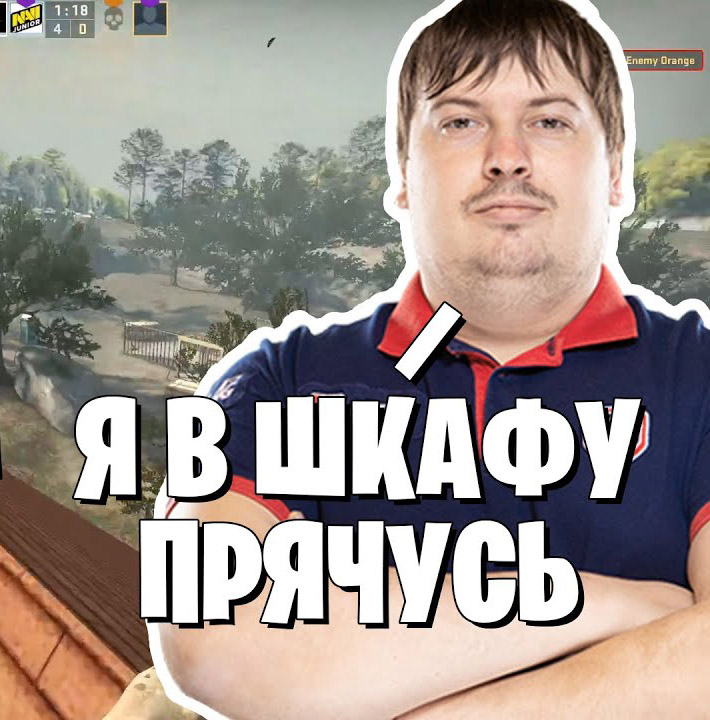
A square image built as a collage. The background is an in-game screenshot showing trees, a fence, and a roof; in the top left corner a game interface is visible with a 4:0 score and a 1:18 timer, and on the right an 'Enemy Orange' marker. Cut out and layered on top is a portrait of a man with a mustache, standing with his arms crossed in a dark blue T-shirt with a red collar, looking straight into the camera with an impassive face.
Over everything, large white letters with a black outline spell out 'I'm hiding in the closet,' and above the stressed vowel a small black mark is drawn, like an accent mark. This style is typical of gaming-video intros: bright, dense, deliberately loud.
Where the phrase comes from
The phrase is attributed to a player known by the handle Dosia. The line itself sounds like an excuse: the person reports where he's hiding and, judging by the tone, isn't the least bit embarrassed that it's not exactly a heroic spot. The exact date, match, and broadcast on which he said it haven't been reliably established; dates online don't agree, and some of the pages with the original source are no longer accessible.
What is known is that in 2020 the phrase caught on as part of a broader trend of parodying gaming-video intros and started being used as a ready-made line. The rest of the description relies on what can be seen in the picture itself.
In the picture itself, the character's T-shirt bears the emblem of the team Natus Vincere, and the game interface carries the label 'Junior'; this gives grounds to connect the shot to the organization's youth roster, though it's impossible to pin down the specific match from it.
Why it's funny
The humor comes from a clash of tone and content. Intros like this usually promise heroics, and here what's declared instead is plain, honest cowardice. The face in the portrait shows neither shame nor worry, which makes the choice of words sound almost businesslike.
The second layer is the logic of the closet itself. You can only hide there inside a house, and the phrase turns a tense match into a children's game of hide-and-seek. That's what makes it so easy to carry over from gaming into everyday life.
Example captions
'The boss calls on a day off' followed below by 'I'm hiding in the closet.' The caption works as an answer to an unasked question: the character doesn't refuse, he simply vanishes.
'When someone in the family group chat asks who's driving to the dacha.' The short phrase turns an awkward situation into an answer with no further words needed.
'Mom: clean your room,' and in the picture, 'I'm hiding in the closet.' Here the closet becomes literal: the trick works not because it's convincing, but because it's so naive.
The picture is also often paired with other templates — for example, with the cringe-thumbnail meme — where the phrase serves as one line among a whole collection.
This same picture is also often mistaken for a shot from a specific real match rather than a random collage: the character's shirt carries the Natus Vincere emblem with the label 'Junior,' and the background holds a game score of 4:0 — it's these details, not just its pairing with other templates, that make the intro look like the real thing.
How to use it
The template suits situations where you need to dodge a conflict, a phone call, cleaning, a meeting, or any task where running away looks funnier than standing your ground. It's best to leave the caption on the picture unchanged: it's precisely the already-familiar phrase that makes the meme recognizable.
Don't invent a backstory for the character or put words in his mouth that he never said: the joke uses a public quote and the image from the picture, not the person's private life.