What's in the frame
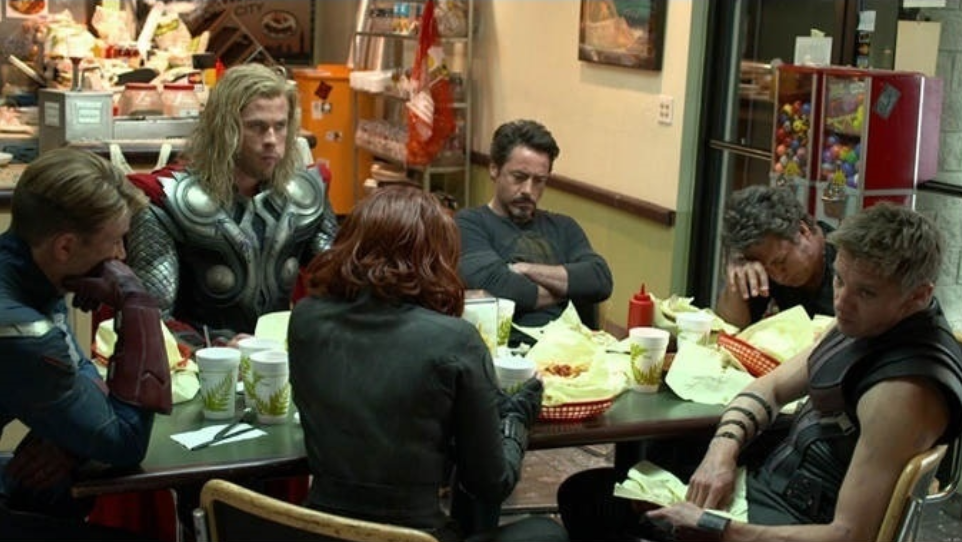
A cramped diner: paper cups, wrappers, and baskets of food sit on the table. On the left, with her back to us, sits a red-haired woman; across from her a man in a dark hoodie with his arms crossed looks off to the side. At the edge, one of the heroes in a blue suit has covered his face with his palm, and next to him a man in shining armor with long light hair stares ahead grimly. On the right there are two more: one has covered his face with a hand, and the other, in dark gear with forearm guards, has leaned back in his chair and is looking to the side.
No one is talking or eating. The atmosphere resembles the silence after a match: everyone is too tired to say anything.
Which movie the frame is from
This is a scene from the Marvel film “The Avengers,” released in 2012. In it, the heroes come together as a team and repel an alien invasion of New York. The diner scene is shown after the battle: the team that has just saved the city sits silently at a table.
The contrast made the frame popular with viewers: people in combat gear who have just won a battle against aliens sit as hopelessly as students after an exam, silently staring ahead and eating nothing.
What the title means
The meme title “Back Desks” connects the frame to a school situation. No precise information about where and when this exact caption appeared could be found, so it is more accurate to treat it as a general name for the template rather than a historical fact. In meaning, it suggests who the heroes are meant to depict: people who sit “in the back row” and watch what is happening from the side.
In Russian-language jokes, “back desks” usually means a company that sticks together, sees everything going on, and is in no hurry to take part. That role fits the heroes of the frame well: they sit together, stay silent, and wait for everything to be over.
Caption examples
“Our class after a test everyone took together.” Shared exhaustion turns into a group portrait.
“Us, one hour into the lecture.” Each hero's tired face reads as a separate line.
“The team after the release: nobody argued, nobody celebrated.” The template works well for work jokes.
“The parents' group chat when someone asked who would collect the money.” Each character looks in their own direction, but everyone is silent.
How to use the template
The picture suits group stories: “we after…,” “our department,” “the family after…”. The principle is always the same: after a tense event comes shared fatigue, and the heroes have nothing to occupy them except food.
Don't attribute moods to the actors, and don't use the photo to mock real people: the film's characters here serve as stand-ins for generic “students.”
The frame can also be captioned character by character: each has their own pose, and each easily turns into a personality. One has covered his face with a hand, another looks to the side, and a third sits with his arms crossed. Assign roles from your own circle of friends, and you get a group portrait in which everyone recognizes themselves.
Short work captions also pair well with the frame: “after the deadline,” “after the meeting,” “after the parent-teacher conference.” One such word is enough to make the whole composition take on a new meaning.