What is in the frame
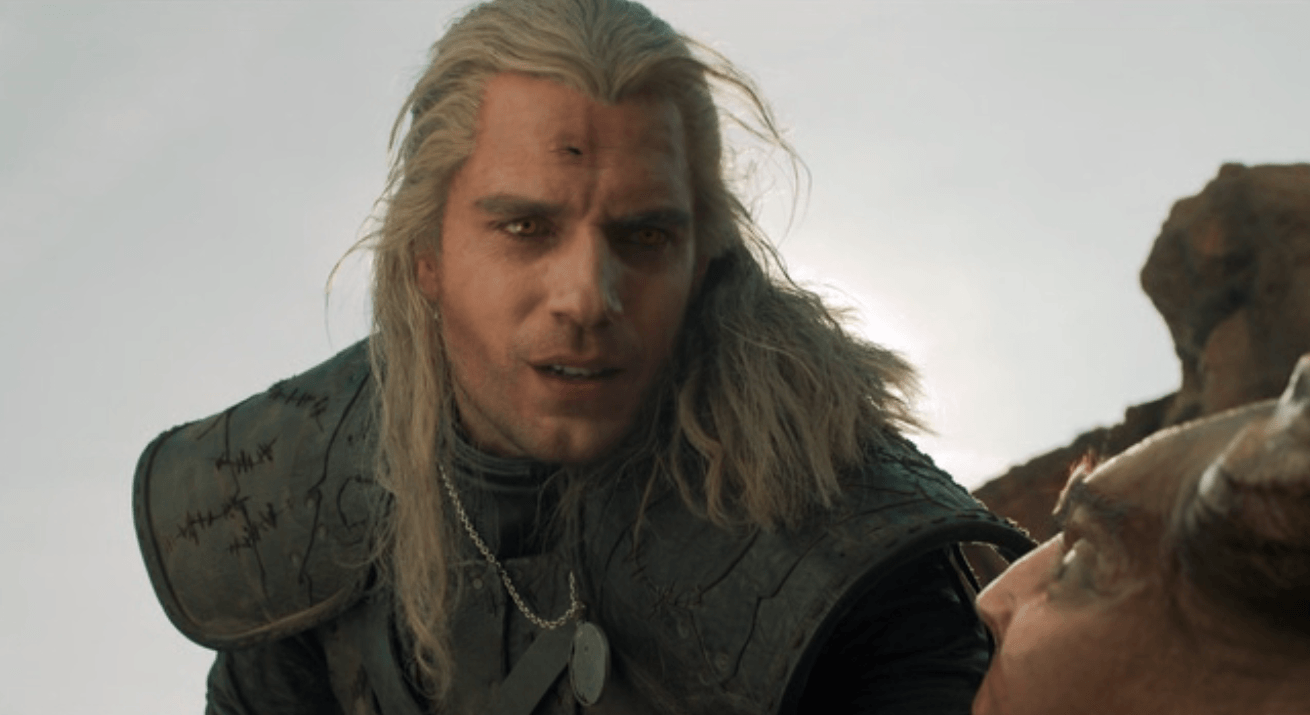
At the center of the frame is a man with long light hair, yellow cat-like eyes, and a small scar on his forehead. This is Geralt of Rivia, played in the series by Henry Cavill. He wears dark leather armor with a shoulder guard, on which traces of threads and seams are visible, and a silver chain with a medallion. He looks straight into the camera, leaning slightly forward, brows furrowed, lips parted as if he is about to say something.
In the lower right corner another character is visible, lying on the ground: part of a face and a horn or protrusion can be seen. The background is a light sky and a reddish cliff. The frame shows no blow or swing: it is more of a conversational moment after a skirmish.
What is known about the source of the phrase
The Netflix series “The Witcher” is based on the books by Andrzej Sapkowski; its first season premiered on December 20, 2019. The hero's appearance in the frame (the scar on his forehead and the patched armor) matches the first season. The specific episode and the name of the conversation partner are not established.
The wording “You are reasonable, that's true” is a meme caption for the frame, presumably a translation or variation of a line rather than necessarily a verbatim quote from the scene. For the joke this is not essential: what matters is the intonation with which Geralt looks at his interlocutor.
Why the caption works
The phrase has two parts: an acknowledgment (“you are reasonable”) and a confirmation (“that's true”). It sounds like a solemn agreement, after which a “but” is expected. Geralt's serious face makes the pathos comic: the person agrees with the argument, but the face shows he is not going to draw the conclusion.
The template is convenient because it describes a very recognizable situation: an argument in which the opponent seems right, yet his conclusion cannot be accepted. The joke rests on the contrast between a polite acknowledgment and stubborn refusal. The more mundane the occasion, the funnier it is.
The template is especially good in dialogues where one participant makes a convincing point while the other still has no intention of changing his decision. Geralt's serious gaze turns the refusal into an almost solemn formula.
Examples of captions
Friend: “Let's rest first and do the homework tomorrow.” Me: “You are reasonable, that's true.” And I sit down to do it today anyway — a contrast between polite agreement and actual action.
Boss: “If we cut the meetings, we'll be more efficient.” Everyone: “You are reasonable, that's true.” The next meeting is scheduled for tomorrow.
Ad: “Use our service, it's profitable.” Me: “You are reasonable, that's true.” And I go to the competitors.
Friend: “Stop arguing with the internet.” Me: “You are reasonable, that's true.” I open a new comment.
How to use the frame
The caption works better as a dialogue: the interlocutor's line on top, the hero's reply below. If you use the phrase as a caption, add a continuation with “but” that reveals the joke. There is no need to explain in detail where the frame comes from: it is recognizable even without explanation. Leave part of the frame with Geralt's face free so the text does not cover his gaze.
The caption can be split into two parts: first the interlocutor's argument, then the line with the picture. Right after it comes that same hidden “but,” which the reader fills in on their own.