What's shown in the picture
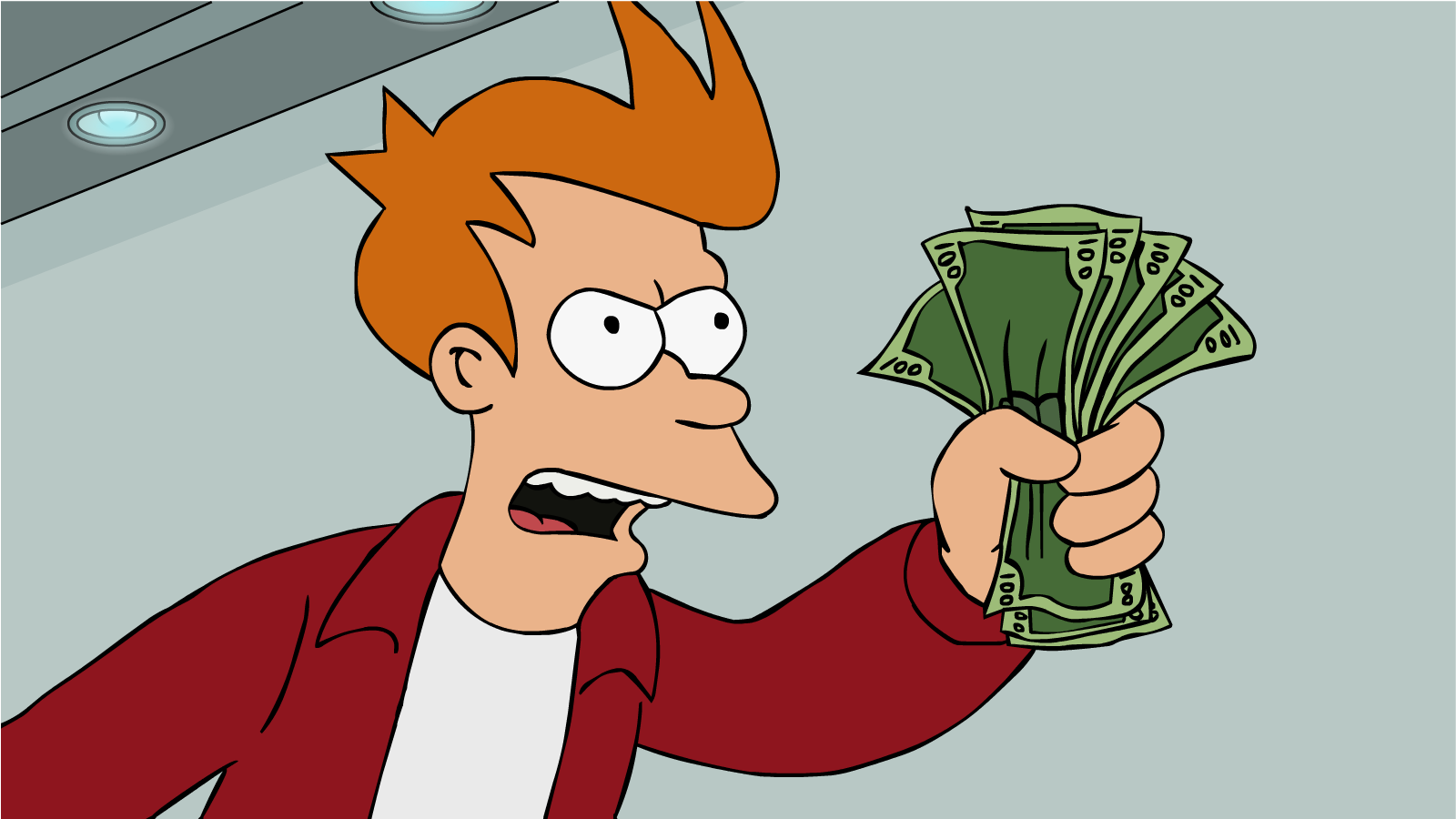
The picture shows Fry, the main character of Futurama, a red-haired delivery boy with his distinctive cowlick, wide-open eyes, and a tensely open mouth. With one hand he holds out a fanned-out wad of green bills, looking at his interlocutor as if expecting instant agreement. The background is gray, with metal ceiling lights overhead, which underscores the ordinariness of the setting.
His pose and expression convey an impulse: Fry is excited, irritated, and impatient all at once. The gesture reads as aggressive generosity, and it's exactly this contrast between the insistent look and the readiness to pay that made the frame a handy template for conversations about purchases and approval. The character looks as if he's about to burst from the urge to pay.
Origin
The line was spoken in an episode of the animated series Futurama, created by Matt Groening and David X. Cohen. The show first aired on Fox in 1999, and after being revived in 2008 it gained a new audience, thanks to which the characters' lines began to be frequently quoted online. It was in that context that the phrase got a second life.
As a meme, the expression began spreading around the early 2010s, when forum and social-media users started using it as a reaction to announcements of new products and games. The exact episode and the date of its first online use have not been firmly established in open sources, so there's no talking about the meme's first author. What matters is only that the phrase quickly took on a life of its own outside the series.
How it's used
The expression has become a universal reaction to something someone wants to buy immediately: a new gadget, a rare release, a convenient backpack, or an unusual book. Captions are usually built on the pattern "A laptop like this — shut up and take my money," and in that form the phrase sounds almost like an enthusiastic compliment to the seller or creator of the product.
The meme is also applied to ideas, not just goods: a new season of a favorite show, a charity project, a useful service, or a remake of an old game. So the expression signals general approval and a willingness to support, not just a desire to pay. This shift in meaning makes the meme flexible and lets it be used in a wide range of situations.
Why the meme works
The joke's mechanism lies in a paradox: the recipient of the phrase, the seller or the product's creator, hears a demand to stop talking — as if any conversation about price and terms is unnecessary. The buyer doesn't ask for more information but immediately offers money, and this turns an ordinary purchase into a comic image of an impulsive fan who can't bear a single minute's delay.
Beyond that, the phrase transfers easily to any area of consumption, which keeps it relevant. The visual element, Fry's vivid reaction and the wad of cash, amplifies the emotion, and its short form makes the meme convenient for comments and ironic approval. The joke registers instantly, which is exactly why it keeps coming back in conversations about tech, games, and new releases.