What is visible in the photo
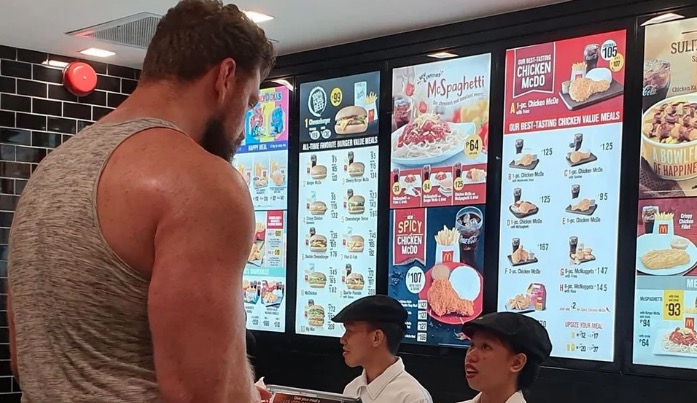
On the left, in the foreground, stands a man turned side-on to the camera, in a gray wrestling-style tank top. He takes up almost the entire foreground. On the right, behind the counter, two workers in black caps and white shirts are visible: they look upward, and their faces are slightly surprised. Bright illuminated menus hang behind them, with photos of dishes, prices and English-language captions, among which spaghetti and fried chicken stand out.
From the menu one can guess the photo was not taken in a Russian restaurant, but this is only a guess based on visible details, not an established fact. Who is pictured and where the photo was taken is not reliably known, so neither a name nor a country is given in the text.
What is known about the source
The exact origin of the photograph remains unidentified. The original post with the author's caption is not known, which means it is impossible to say when the picture appeared or who took it. Pictures like this are often spread without a primary source: someone takes a shot, shows it to friends, and then it ends up in discussions and collections.
That is why, for the meme, what matters is not the person's identity but the visual scene: a huge silhouette against an ordinary order window. It is not acceptable to attribute to the person pictured a character, profession, habits or sporting past based on a meme caption, and this joke has nothing to do with his biography.
Why the scale contrast works
The joke is built on a very simple device: two scales in one frame. The staff look disproportionately small, although they stand very close. Because of the angle and the camera position, an effect arises as if something enormous has come for an ordinary order. The familiar, peaceful interior of a fast-food restaurant only strengthens the effect.
In captions the picture usually turns into a “big versus small” scheme: a problem and its solution, a person and bureaucracy, a boss and subordinates, ambition and budget. Any relationship in which one side clearly outweighs the other fits this frame.
Caption examples
All examples are invented for illustration. They do not refer to the person in the photo.
“My to-do list for Monday: I'm at the order counter on Saturday evening.” The customer becomes a huge list, and the workers behind the till look like ordinary anxious deadlines.
“The size of my desire to have lunch versus the size of my salary before payday.” Here the large silhouette stands for appetite, and the tiny figures behind the counter symbolize the budget.
“A new task from the client that will take five minutes.” A meme about a project that grows and grows every minute while the performers stand and look up.
“My tiredness on Thursday versus my desire to go for a run.” One side clearly outweighs the other, and the viewer immediately sees which one.
How to use the picture
Captions work better when the big thing is something abstract: appetite, a deadline, a to-do list, waiting. If you caption the meme with real people, it is easy to slip into a hurtful tone. So the rule is simple: joke about situations, not about the appearance of the people in the picture.
One more recommendation: keep the caption short. The size in the frame already says everything, and a long explanation only weakens the impression. A good caption takes one line, and a second line is enough for an unexpected detail.