Three bees and an inscription
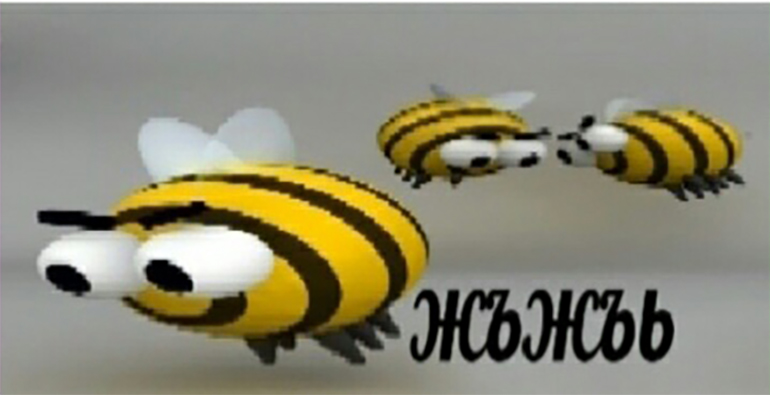
The image resembles an early low-resolution computer render: pixelation is noticeable, and the bees have simple shadows and highlights. The large bee on the left has a yellow-and-black striped body, two big white eyes with black pupils and a dark brow that makes its gaze look sly. Its wings are light and almost transparent. Two smaller bees fly behind it. The background is gray and blurred.
At the bottom, next to the large bee, “ЖъЖъь” is written in black calligraphic lettering. It is the inscription that makes the picture a meme: without it these are just cartoon insects, but with it comes an intonation.
A sound instead of a meaning
The title is built on onomatopoeia: “zhzh” conveys buzzing, while the unusual spelling with a hard sign stretches the sound and makes it comical. The word itself is absent here, and that is the whole effect.
The inscription works like noise: it can be read aloud, added to a cute picture or to a message where a light intonation is needed. That’s why the meme rests on tone rather than plot.
It is also curious that the hard sign in the middle of the word appears nowhere else in Russian: it carries no sound and only holds a pause, as if imitating a buzzing vibration. So the inscription physically resembles the sound it denotes rather than an ordinary word.
Where the picture came from
The origin of the image is not reliably established: it is unknown which video, game or animation the bees come from, or who the author is. Versions about the creator and the exact time of appearance are unconfirmed, so it’s better not to repeat them.
All that is known is what is visible in the frame itself: the low resolution and the style of early 3D graphics. That is enough to understand why the image is perceived as a funny relic of the internet.
Captions that sound like buzzing
The examples are invented for this picture. All of them use what the inscription already does: it sounds like a light hum and adds cheerful madness.
“Zhzhz, still got a whole day of errands.” The inscription becomes a comment: the sound stands behind the words and adds ironic calm.
“The call has been going on for four hours, zhzhz.” The contrast between work fatigue and cheerful bees gives the same tone as the picture itself.
“Buzzing around all day with my errands, just like these three in the picture.” The inscription here directly points to the bees from the picture rather than simply depicting random noise.
Why it works: the inscription doesn’t explain, it sets the intonation. The shorter the caption, the better it sounds.
A good caption for such a picture usually consists of one everyday situation and the “zhzhz” itself at the start or end. The word works as a sound marker: it softens a complaint, turns fatigue into a joke and takes the seriousness out of any message. That’s why it’s so easy to insert into both chats and comments.
How to apply the picture
The picture suits light and kind occasions: cute everyday trifles, small wins, funny mistakes. It is poorly suited to sharp irony, because the bees look harmless and immediately set a gentle tone.
If you write your own text, keep the inscription in its original spelling: recognizability comes from its form, not its meaning. Don’t invent origin stories for the picture: any such detail would be speculation.