Where the still comes from
Charlie Jones is the father of the main character in the stop-motion animated film Coraline (2009). The film was released by Laika studio in 2009, directed by Henry Selick, and based on Neil Gaiman's 2002 novella. In the English version, the character was voiced by John Hodgman, and Coraline herself by Dakota Fanning.
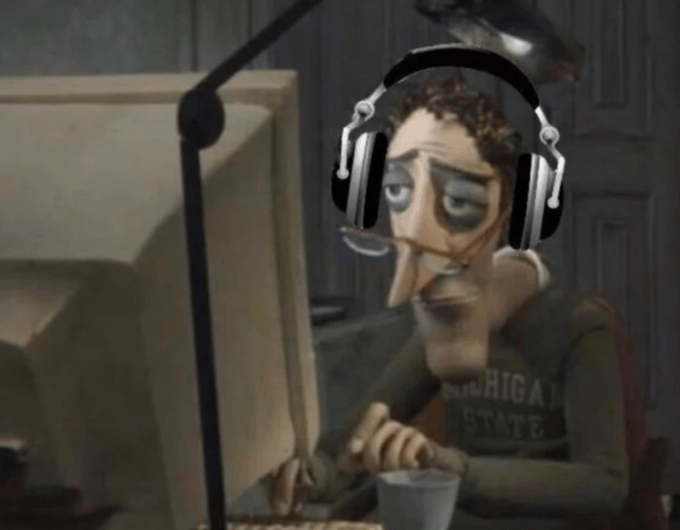
In the film, the parents are busy with work and pay little attention to their daughter, so the viewer is left with the image of a tired adult who has no time for other people's problems. Charlie is not a villain or a neighbor, as is sometimes mistakenly written, but an ordinary family man. The most famous frame shows him at the computer: he is hunched over, his eyes ringed with dark circles, and he wears a gray hoodie with a slogan about Michigan State University.
What the meme version looks like
In the template from the collection, large black-and-silver headphones have been drawn onto the frame: they rest over the character's head, so he looks like a gamer who has stayed up past midnight. A mug sits on the desk, a floor lamp stands on the left, and a bulky old monitor is in front of him. All of this works as a recognizable backdrop for a tired evening.
The combination of details creates the sense that the person has been at the computer for a long time, nothing is moving forward, and he cannot pull himself out of the state. That is why the picture fits equally well a streamer, an office worker, or a student sitting down to a coursework assignment.
When and how the meme became popular
According to meme reviews, the first mentions of the screenshot date to 2018, when it was posted on Tumblr, but it truly became popular in March 2020, when the pandemic began and many people switched to remote work. A young Twitter user then captioned the frame with words about his own state, and the image was picked up. By the end of June it had been noticed on Reddit, where posts and videos featuring it were gaining thousands of votes.
The rest is unconfirmed: how the idea with the headphones arose and who drew them is unknown. What is reliably established is that the template took hold in 2020 as a meme about emotional burnout and monotonous days spent in lockdown.
What it means
The main emotion is not drama but quiet fatigue. The character does not cry or complain; he simply sits in front of the screen with a face as if he had figured everything out an hour ago. The joke rests on captions describing familiar states: an endless video call, the thirtieth episode in a row, an email marked “urgent.”
The cartoonishness matters too: this is not a real person, so the caption does not turn into mockery of someone's appearance. The face looks tired because of the stop-motion animation style, not because of an actor's pose.
Caption examples
“I'm three hours into a call that could have been an email.” The caption describes typical work-related boredom and fits the desk in the frame.
“I have three more chapters before the exam, and I've read the same page for the eighth time.” A joke about how being at the desk is not the same as working.
“Gaming session at 3:40 AM: ‘just one more match and then sleep.’” The headphones make this caption the most precise.
“My brain on Friday at 5:55 PM.” A short caption without extra details works no worse than a long one.
Tips for use
The meme works best in comments or replies to posts about overload and dull routine. Write a specific situation rather than an abstract “I feel bad”: the contrast between a neutral fact and an exhausted face is what makes it funny. Do not use the template for serious conversations about health: it is about everyday fatigue, not a diagnosis.