The inscription before the final battle
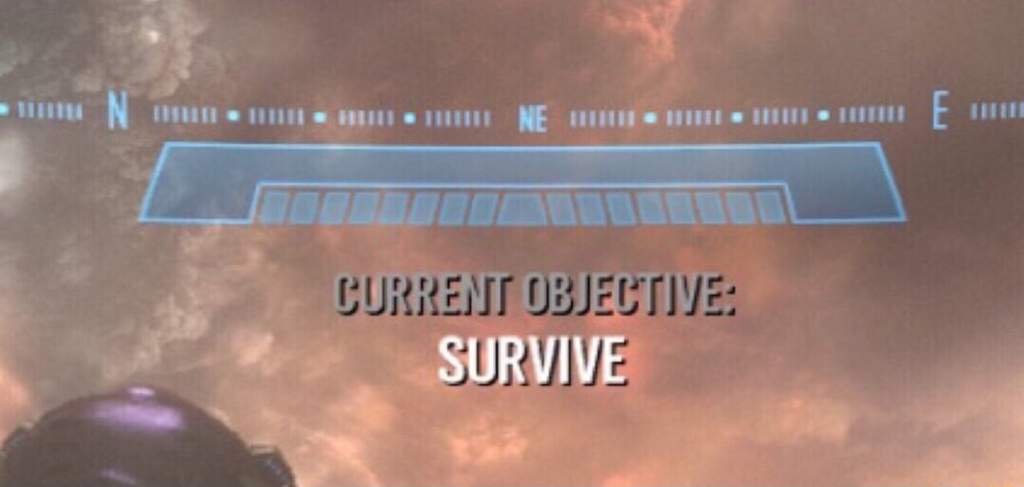
The image has almost no surroundings: a semi-transparent game bar runs along the top edge, and in the center, over an orange smoky sky, stands the inscription “CURRENT OBJECTIVE: SURVIVE.” At the bottom left, the edge of a Spartan's helmet is visible. This is not a text plate over an arbitrary frame, but part of the Halo: Reach interface. Because of the empty space and the short command, it reads as an order left after all other tasks have disappeared.
In the game the command belongs to the Lone Wolf mission. By this point Noble Six has already delivered an important cargo to Captain Keyes, and the *Pillar of Autumn* has left Reach; the Spartan remains for the final battle. The official Halo description refers to the final stand on Reach, which has already fallen. So the short word “survive” sounds not like a triumphant slogan, but like a goal limited to the very fact of holding on.
From the Reach ending to an online reaction
Halo: Reach came out in 2010, and Lone Wolf concludes the campaign. Later players began cutting this built-in inscription out and attaching it to entirely different episodes. Dated online traces of the finished meme date from 2017–2018, noticeably later than the game's release. The first author of this usage is not named; early examples show how a screen from the finale became a standalone reaction.
The transfer changes the scale. In the game, the character really does stay on the battlefield after the outcome can no longer be turned around; in an everyday joke, a similar formula can describe a clinic queue, a rush before a project deadline, or a family dinner with a long pause. Because of the grave game presentation, a small inconvenience acquires almost epic weight. What is funny is not that the task is dangerous, but that the interface announces it with the same dispassion.
Why the terse command works
The inscription does not explain how exactly to survive or what to do next. It fixes the minimal goal after the usual landmarks disappear: win, save the team, complete the mission. In meme use, the viewer fills in for themselves what has drained their strength. If three documents are already open on the desk and a call starts in five minutes, the phrase sounds like an honest summary of a work plan rather than an exaggeration for a beautiful quote.
The difference between the game interface and human speech also helps here. A HUD usually speaks precisely and economically; in everyday situations people explain themselves longer and more gently. When a stern screen replaces that explanation, the everyday “I'm at my limit” turns into a universal task. But the image keeps a trace of the original: behind the simplicity of the word stands a story in which the hero's survival is not guaranteed.
Invented uses
An invented example: a student opens a laptop in the morning before an exam and places the screen “Current Objective: Survive” beside it. The goal is not to master the whole course in an hour, but to calmly reach the lecture hall and remember at least the basics. Here the joke lies in comparing the game with the ordinary fear of being tested; the caption does not promise easy success.
Another invented variant is a kitchen timer against a stack of dishes: “Current Objective: Survive” until the guests arrive. In such a caption the hero is not saving the world, but trying to finish cleaning before the doorbell rings. The more mundane the task and the sterner the interface looks, the more noticeable the disproportion. The same screen could be attached to a long trip with transfers: the goal changes not to victory, but to reaching the nearest clear point.