A motto with a military ring
The phrase “Improvise. Adapt. Overcome” is often cited as an unofficial motto of the United States Marine Corps. It expresses a simple idea: if the original plan collapses, you should not panic but change your actions on the fly and still see the job through. A formula of three verbs is easy to remember, so it has long lived outside the military: it is printed on T-shirts, used as screensavers, and repeated in motivational videos.
It is exactly the seriousness that makes the motto good material for a joke. Three short commands sound like an order for a real ordeal, and once you apply them to something very small, a comic distortion appears.
What is visible in the frame
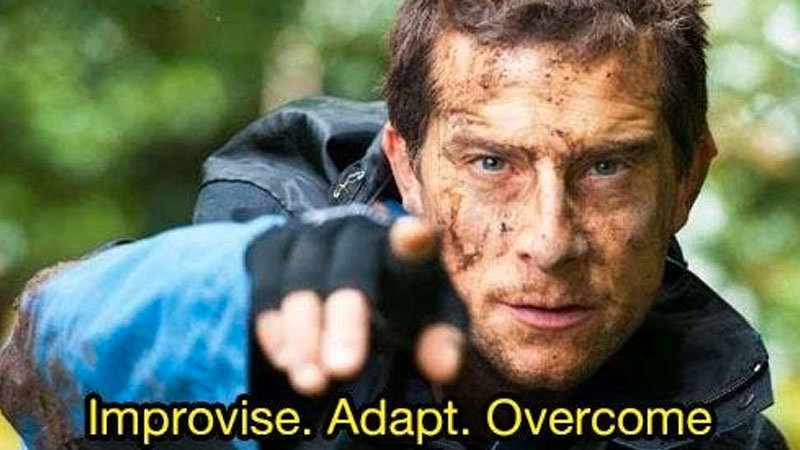
The picture shows a man in a close-up, roughly from the shoulders up. He looks straight into the camera with light eyes, his face and jacket are smeared with dirt, and his right hand in a black fingerless glove is thrust forward, so that a finger almost touches the lens. The background is blurred and green, as if the action takes place in a forest. The phrase itself is set at the bottom in large yellow type.
The man in the frame is usually named as Bear Grylls, the host of the show “Man vs. Wild,” which aired on Discovery from 2006 to 2011. The show was built on the host demonstrating survival techniques in harsh terrain, so the image of a determined man in mud reads instantly. The anxious, demanding hand gesture turns the picture into an address to the viewer, as if the hero personally demands that you do not give up.
How the frame became a template
English-language analyses link the spread of the template to 2017, when the phrase in the yellow caption began appearing on forums and meme communities. The exact first post and its author have not been established, so one cannot say with confidence who first combined the frame and the motto.
The further path is typical of universal templates: jokes about broken plans, work crunches, and household mishaps quickly accumulated, and the frame itself began to be used even without a caption, as a sign of “got through it, if in a strange way.”
Captions of your own
Below are four invented captions. Each is built the same way: a solemn command and a tiny problem.
“The sugar ran out, so the coffee is now with honey.” The motto turns into an excuse, and the honey stands for victory over circumstances. It's funny that the solution also worked.
“The restaurant is closed, so we're having instant noodles on a bench by the entrance.” The more mundane the outcome, the stronger the contrast with the solemn tone.
“I was late to the meeting, went in through the service entrance, and pretended that was the plan all along.” The caption keeps the hero's pose: the plan failed, but the confidence stayed.
“I forgot the charger, so I'm saving battery all day and talking out loud instead of texting.” An everyday difficulty is presented as a survival trial.
Why the joke works and how to use it
The comedy rests on three components: a serious tone, a specific action, and a disproportionate occasion. Remove the tone and the caption stops sounding like a motto. Remove the action and only empty declamation remains. If the occasion becomes too significant, the contrast disappears.
Captions that describe a solution found work best, rather than a complaint: the template favors heroes who manage, even absurdly. One line is enough. A long explanation weakens the effect, because the frame already reads as a short order.