The kitchen, a straw, and a purple heart
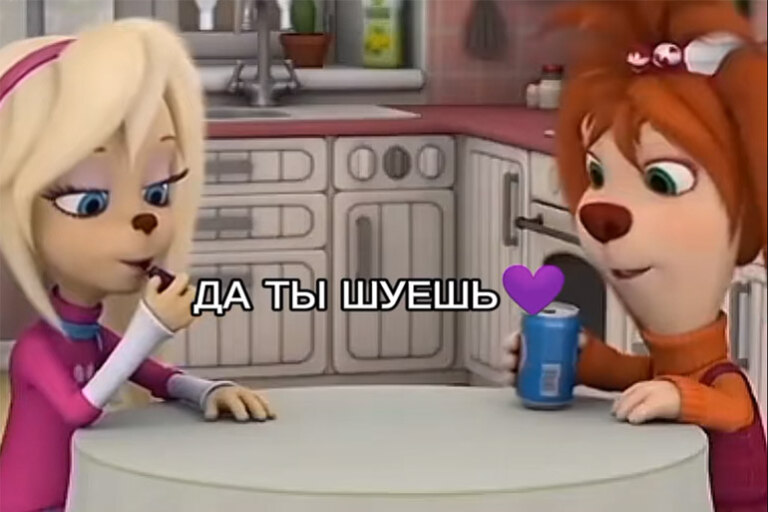
The action takes place in a kitchen: light-colored cabinets, a stove, a table. On the left sits a cartoon dog with long blonde hair and a pink bow, drinking through a straw and looking off to the side. On the right is a ginger dog in an orange sweater, holding a blue can, with a purple heart drawn next to her.
The characters are rendered in 3D animation and belong to the well-known Russian series "Barboskiny." Recognizability is doing work for the joke here: the viewer immediately knows where the shot is from and isn't expecting a twist.
Across the center, over the image, sits a caption in large outlined letters — a garbled version of the familiar phrase "you're kidding." The text itself is spelled the way a generated voice pronounces it: with dropped and jumbled sounds. So the image and the text work together: one pulls toward the familiar, the other immediately breaks the expectation.
Seedance 2.0 and broken Russian speech
This is a meme created by a neural network. According to media reports, the clips appeared in March 2026 in short videos and were made using Seedance 2.0, a Chinese video-generation model from ByteDance.
The model struggled with Russian speech: the characters opened their mouths, but the sounds that came out were garbled. Instead of "da ty shutish'" ("you're kidding"), what came out was something like "da ty shuesh." This flaw was never fixed — on the contrary, it became the meme's main feature.
Other names for the format have appeared too, coined by users. Among them are variants about a continuation of the cartoon and about a character who's become "half-squirrel." They all describe the same thing: a familiar picture spoiled by the generation process.
Why a generation error became the main point
The familiar picture and the broken speech work against each other: the cartoon characters are recognized instantly, while the sound seems to fail them, producing an uneasy feeling. The laughter sits side by side with mild discomfort.
The anchor is the recognizable intonation of surprise. The phrase "you're kidding" expresses disbelief, and even garbled it still reads clearly. One word is enough to grasp the meaning. That's why the caption is easily recognized even without the image.
And one more thing: it's obvious the clip was made by a machine, and that's part of the appeal. The viewer isn't watching for the plot, but for exactly how the model messed up this time.
The heating bill and the final edit: sample captions
"Opened the heating bill. Da ty shuesh." The reaction of disbelief suits household sums that are out of a person's control.
"The boss said the meeting would be short. Da ty shuesh." The caption expresses the same disbelief, but now aimed at promises rather than numbers.
"Checked how many pages are in the document I need to proofread. Da ty shuesh." Here the garbled phrase conveys surprise at the scale of the task.
"They told me this is the last edit. Da ty shuesh." A version where the joke rests on experience: everyone already knows the edit is never really the last one.
What these captions have in common is the moment when a person hears something they can't quite believe. The garbled word works here as an honest reaction: there simply aren't normal words for something like that.
Why the distortion is the joke
A short caption works best: one phrase expressing disbelief. The fewer the words, the stronger the effect, because the joke rests on sound, not text.
Don't try to fix the distortion. Spell the phrase correctly, and the whole point disappears: the meme exists precisely because of the generation error, and a "correct" version would just be a quote from the cartoon.
If you want to make your own version, leave the same glitch in the text: what matters isn't the picture but exactly that mismatch between image and sound.