What's shown
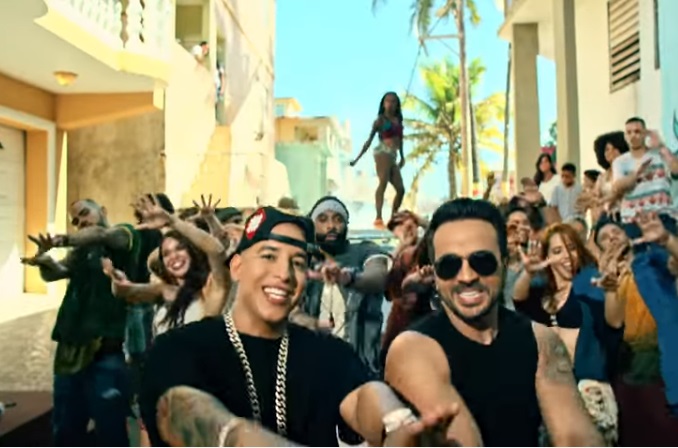
The video still shows a street in a Puerto Rican town with pastel-colored houses, balconies, and palm trees. At the center are two performers: on the right, Luis Fonsi in dark sunglasses and a black tank top; on the left, Daddy Yankee in a cap with a heavy chain. Around them is a crowd of dancing people, many reaching their hands toward the camera, while a woman dances on a raised platform in the background.
The image conveys the festive, sunny mood of the video, which matches how the song is perceived in memes: light, summery, and infectious. The performers themselves are smiling, and their pose, which resembles an invitation to join the dance, also became part of the recognizable image.
It's important to understand that the meme isn't tied to a specific scene but to the song itself. The still is recognizable, but in reworkings it's usually used only as a symbol of the melody, so the photo serves more as an illustration of the broader cultural phenomenon.
The song's history
The song came out on January 13, 2017 on Universal Music Latin and became the first single from Luis Fonsi's album "Vida." The official video had appeared on his channel a day earlier. In February the track topped the Hot Latin Songs chart and held the number-one spot for 22 weeks.
In April 2017 a remix featuring Justin Bieber was released, in which he sang in Spanish for the first time, with part of the lyrics in English. The remix helped the song break out of its Spanish-speaking audience and became one of the main turning points in its popularity.
Among its most famous records are one billion video views in 97 days, the second-fastest to that mark on YouTube at the time, and two billion in 154 days, the first video ever to reach that. From August 2017 to November 2020 the video remained YouTube's most-watched. In July 2017 the song became the most-streamed in the world, and in February 2018 the remix became the first predominantly Spanish-language track to pass one billion streams on Spotify.
Why the song became a meme
The key reason is ubiquity. In the summer of 2017 Despacito played in cafes, cars, and at parties, and many people grew tired of it. That fatigue produced jokes about the song being played too often, and the meme began to feed on irritation and affection at the same time.
The second reason is the melody's adaptability. Fonsi said the song translates well into different genres, and journalists noted how instantly memorable it was. The simple rhythm and repeating chorus made it easy to rework the song in any style without losing recognizability.
The third reason is the media stories surrounding the song. The Bieber remix and his performances kept making headlines, sustaining interest in the melody beyond the music charts.
Parodies, reworkings, and politics
Parodies appeared almost immediately after release. A video by oRni, posted on January 17, 2017, racked up more than 34 million views, while the parody "ESE GRINGO" got around 28 million. Greek performer So Tiri released a viral parody the same year, and in 2024 Weird Al Yankovic included the song in his polka medley.
In April 2017, during a concert in Puerto Rico, Bieber sang the word "blah" instead of the Spanish lyrics, and footage of this moment spread widely in May 2017. The joke about his performance became one of the most frequently cited episodes of the meme. In August 2017 James Corden released his own remix with ironic jabs at Donald Trump.
The melody was also used by politicians and parties with rewritten lyrics, including in an Argentine election ad and in a campaign for Venezuelan president Nicolás Maduro. Luis Fonsi, Daddy Yankee, and Erika Ender publicly objected to its use in Venezuela. These episodes show just how recognizable a sign the song became, one that could easily be fitted into any agenda.
Takeaway
Despacito remains a telling example of how a major hit turns into internet material. Its success rested on a combination of massive popularity, an infectious melody, and reworkings that reflected the public's attitude, ranging from delight to fatigue.
The meme has no single author and isn't tied to one platform: it lived on YouTube, on social media, in the news, and even in political advertising. Thanks to that, the song became a symbol of the summer of 2017, and it's still recognized by its first notes.