What's in the photo
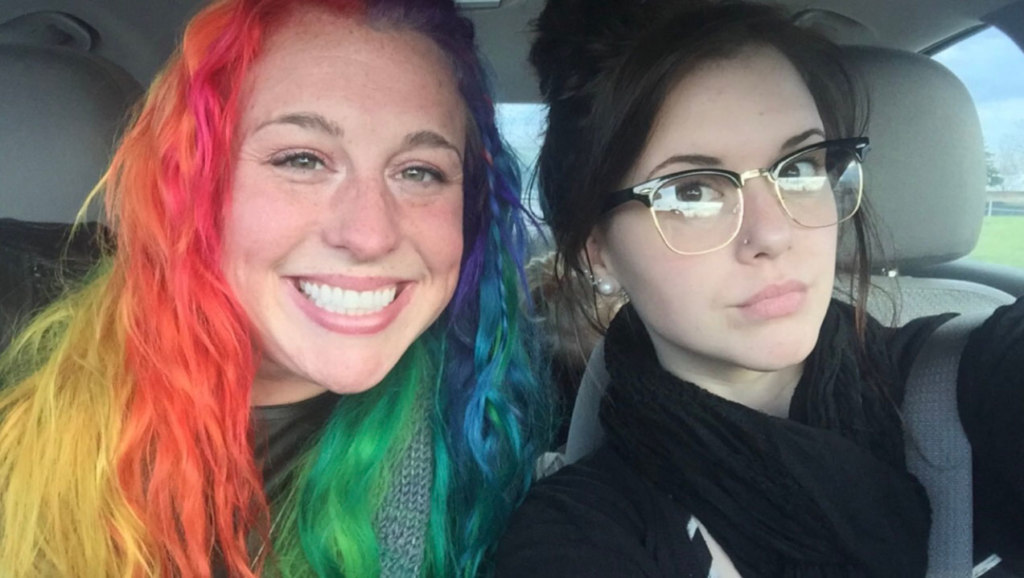
This is a selfie taken inside a car: headrests and a window are visible behind them, with a green field beyond the glass. On the left is a woman with long wavy hair dyed in rainbow colors, from red and orange through to green and blue. She's smiling broadly and looking straight at the camera.
On the right is a second woman with dark hair pulled into a bun, wearing glasses with gold-colored frames and a black scarf. Her face is calm, her lips pressed together, her gaze slightly mocking. The emotions in the photo are easy to read, but a single frame can't tell you anything real about these people's actual personalities: the smile and the seriousness could both have been random.
Where the tweet came from
Reportedly, the photo was posted on Twitter in July 2019 by one of the sisters, captioned "My sister and I are total opposites. Her house vs. mine." Photos of their homes were attached to the selfie. One sister's yard had a colorful fence and an inflatable unicorn in the pool; the other's had a doormat with a message telling visitors to leave, plus a coffin-shaped birdhouse.
The tweet quickly racked up a huge number of likes, and readers wrote that the sisters should get their own show. The selfie was later cropped out of context and used on its own, without the photos of the houses.
How the meme became a template
By 2020, the picture had started being used as a universal template: captions on the left and right would label two phenomena that share the same nature but present a different image. A classic example is a comparison of two related but dissimilar things: countries with a common root and different fates, two versions of the same piece of software, two generations of the same series.
The joke relies on a simple visual rule: bright on the left, strict on the right. Viewers don't need to read any explanation, just the captions above each head. That economy is the main reason the template caught on.
Example captions
Invented examples for the template.
On the left, "The first version of the website," on the right, "The second version after the redesign": here the contrast is in the design.
On the left, "The first movie, when everyone was dreading the sequel," on the right, "The third installment, which nobody expected anything from anymore": one franchise, two very different attitudes toward it.
On the left, "My plan for the weekend," on the right, "What actually happened": a bright expectation and a calm reality.
On the left, "The office New Year's party at the start," on the right, "...at the end": a mood shift over the course of one evening.
How to use it
Pick two things that share some kinship: that way the contrast reads more vividly. If the comparison is arbitrary, the joke loses its edge.
The assignment of roles matters too. The rainbow side usually gets the louder, more emotional image, the black side the restrained, ironic one. You can swap them, but then the meaning flips as well.
Don't attribute actions or personalities to these actual people: they're real sisters, and the meme is describing situations, not personalities. Captions are better built around objects, habits, and phenomena.
The template doesn't have to depict a strict "good" and "bad": the rainbow side isn't always the winner, and the strict black side isn't always the loser. The more interesting pairings are the ones where both options are true in their own way, like the loud and quiet versions of the same place — then the viewer gets to decide which side feels closer to them.