What is shown in the picture
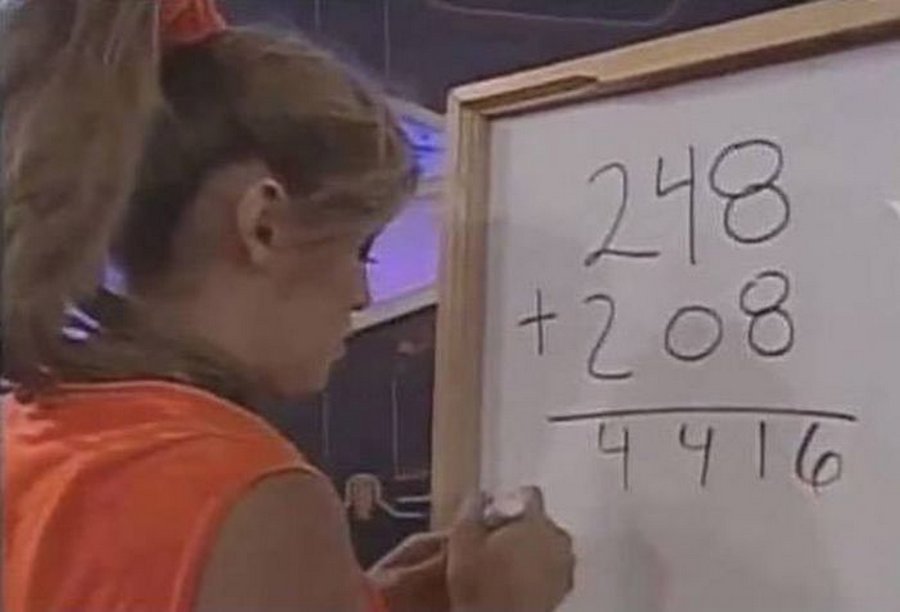
The photo shows a young woman with her hair in a ponytail, wearing an orange tank top, standing close to a white magnetic whiteboard in a wooden frame. Two numbers, 248 and 208, are written large on the board under an addition sign, with the result 4416 written below the line. The woman holds a marker and looks at the board. Judging by the framing, this is a still from a TV show clip shot in a studio, with the characteristic blue lighting in the background.
Origin
The picture comes from a TV show segment in which a participant was supposed to add 248 and 208 on the board. Instead of the correct 456, she wrote 4416, apparently mixing up the column-addition order and tacking on extra digits. Materials that accompany the picture when it is shared point to 2016 and a TV origin for the clip, but sources disagree on the show’s name, channel, and country, or do not name them at all, so the context of the episode remains not fully established.
Despite the uncertain source, the picture of the wrong sum has taken root online as a standalone unit and has been used for years regardless of what the show actually was.
Why the picture became a meme
The error in the picture is not a typo or a minor slip but a gross, glaring mismatch: instead of a three-digit answer, the woman writes a four-digit one, so far from correct that the absurdity of the result is obvious at a glance, with no need to check the math. The participant’s serious, concentrated expression as she writes the wrong answer adds to the comic effect. The viewer sees a person completely sure of herself at the moment of an obvious mistake.
It is exactly this combination (total seriousness of the process and a flagrantly wrong result) that made the picture a universal illustration for any situation where someone acts incorrectly but remains fully convinced they are right.
How the meme is used
The image is posted as a reaction to obviously wrong but confidently stated claims: in arguments, when discussing a colleague’s obvious slip-ups or one’s own bad decisions. Typical captions include “When you’re sure of your answer on an exam, and then you see the grade” or “My plan for saving money this month.” Both play on the mismatch between confidence in the process and the absurdity of the outcome.
The picture is also used with no caption at all, as a standalone comment on any situation with an obvious logical or arithmetic error. It reads without any explanation.
The meme among other viral TV stills
The meme belongs to a broad category of internet images built on short fragments of TV programs, in which participants make conspicuous mistakes or strange moves on camera. Such frames are regularly pulled out of broadcasts and live on in social networks for years after the original show aired, often losing all connection to their original context, as happened in this case too.