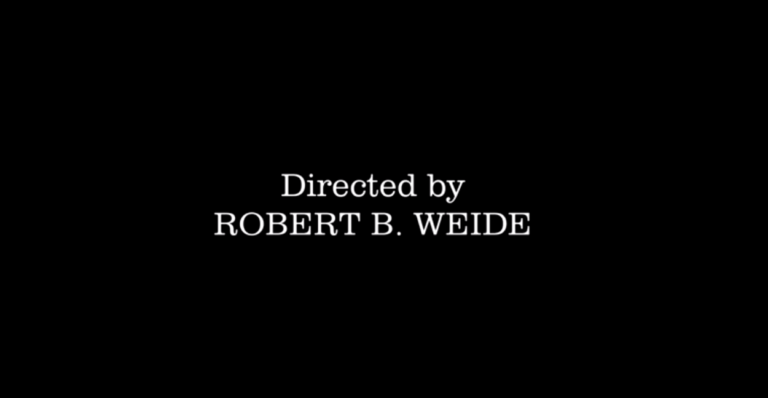
Frame: just text on a black background
The image has no scene and no people. There is a black background and two lines of light serif type: “Directed by” and beneath it “ROBERT B. WEIDE” in capitals. The caption looks like an ordinary credit from the beginning or end of a film.
It is this simplicity that makes it recognizable. The card is easy to insert into any video, and the viewer immediately understands that what is shown should be taken as an episode of a comedy about awkward situations.
Who Robert B. Weide is
Robert B. Weide is an American director and producer, born in 1959. He is known for his documentaries about comedians, in particular about Lenny Bruce and W.C. Fields, and for the series Curb Your Enthusiasm for HBO.
The series was created and is starred in by Larry David, while Weide was the director and executive producer. In 2003 he won an Emmy for directing a comedy series; the award went to the episode “Krazee-Eyez Killa” from the third season. His name is in the credits of this series, which is where the frame is taken from.
Where the credit comes from in videos
The credit refers to the ending of episodes of Curb Your Enthusiasm. Users began attributing the direction of viral videos to Weide, and the joke spread beyond fans of the series: showing this caption is enough to say “this deserves a Larry David episode.”
Sources describe the placement of the credit differently: some refer to the final credits, others to the musical opening and the ending together. The date of the meme's first appearance in videos has not been reliably established; publications about it date from different years, but these are discussions of the phenomenon, not a starting point.
Caption examples
“The neighbor decided to paint the fence without a ladder.” The clip shows a short, ridiculous scene, and the credit at the end turns it into a staged production.
“Tried to stand on one leg in a boat.” The caption describes an intention, and the credit adds irony: everything looks as if it were planned that way.
“The cat tried to jump over the curtain but misjudged the height.” The credit works as a frame that turns a small failure into a comedic episode.
“This is what the plan “quickly wash the windows” looks like.” The formula sets the expectation of a neat result, the clip shows the opposite, and the credit closes the gap.
How to build such a clip
The credit works after a short, clear scene. If the plot is convoluted, the viewer does not have time to catch the irony. It is better to place the caption after one obvious turn, when the awkwardness has reached its peak.
A pause also works well: if a few seconds of silence are left on screen before the caption, the viewer has time to register the absurdity of the scene, and the appearance of the credit sounds like a full stop. An overly fast edit, on the other hand, blurs the effect. Another technique is to use the credit after a mishap by the video's own author, not someone else's.
It is worth choosing scenes where no one was seriously hurt: then the irony stays aimed at the situation rather than at the person. The credit thus works as a frame for an everyday mishap, not as mockery of someone's misfortune.