A family snapshot and a fictional villain
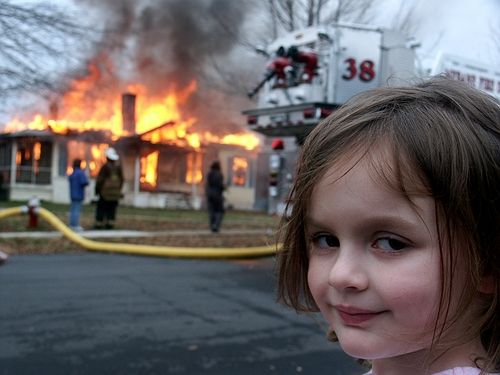
The photograph shows Zoe Roth. Her father Dave took it in January 2005 in North Carolina, when the family went to watch a burning house nearby. The building had been donated for a fire department training exercise, and neighborhood children could try spraying the flames with a hose. Dave took many photographs; his daughter’s unusual expression drew attention later.
In 2007, Dave Roth uploaded one of the photographs to the photo-sharing site Zooomr under the title Firestarter. In November he entered it in JPG Magazine’s “Emotion Capture” contest; the photo won and appeared in the February–March 2008 issue. JPG Magazine later shared it online, where it spread through Fark, Reddit and eBaum’s World. Users began placing Zoe in other disaster scenes, turning a family photograph into Disaster Girl.
The name Disaster Girl refers to a role invented by viewers. The photograph does not show that Zoe started the fire and does not confirm any malicious intent. The joke is built on a false causal link: the person is near an event and looks at the camera in an unusual way, so the imagination attributes a secret plan to her.
How a look creates a whole story
The face is turned toward the viewer, not toward the fire. This makes the camera seem like a participant in a small secret. Instead of the usual reaction to what is happening, we get an almost conspiratorial confirmation: everything is going as planned. The caption merely specifies which exact plan we are invited to imagine.
Invented captions without a literal catastrophe
"Just asked in the family chat whose recipe for Olivier salad (a Russian holiday potato salad) is the right one." The house on fire turns into a stormy discussion, and the calm look becomes the reaction of someone who understands the power of her question.
"Suggested picking a movie by vote. An hour later we have three coalitions and a separate chat." Here a small decision sets off a wildly disproportionate process.
"Changed one setting in the shared spreadsheet. Now every department has a new theory." The joke suits self-irony about accidental interference, as long as the context makes clear there is no real damage.
"Said I knew a shortcut. The tour of the backyards is in its third hour." The image emphasizes the attempt to keep up a confident air after a dubious decision.
In these examples, the flames stand for an argument, wasted time or general confusion. An ordinary trigger contrasts with a spectacular background, while the girl’s look lets the person posting the joke briefly play someone who had planned the whole thing in advance.
The brother who also stood in front of the fire
Dave also photographed Zoe’s older brother, Tristan, that day. His picture had the same burning house in the background, but the result looked different: he wore Harry Potter glasses, his face was slightly out of focus, and the composition did less to emphasize his expression. Dave later described these details when discussing why his daughter’s photograph drew the attention.
The contrast shows how much a particular instant matters. The same event and photographer produced two different portraits; the internet picked the one whose look could suggest an unspoken remark. The Roth family did not invent the name Disaster Girl. Dave originally called his photograph Firestarter, remembering the Drew Barrymore film.