The phrase and the visual motif
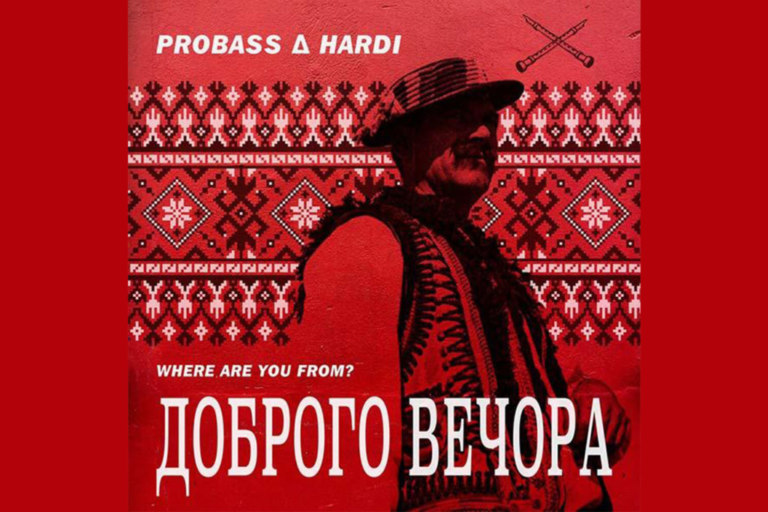
The picture is done in red and black, with a pixelated pattern and the silhouette of a Cossack. At the top it reads PROBASS ∆ HARDI, and below is the English question "Where are you from?" and the answer "Dobroho vechora." This is a graphic variant of the musical meme, not a photo of a specific Ukrainian. In its most common form, the phrase is "Dobroho vechora, my z Ukrayiny" — "Good evening, we are from Ukraine." The version in the picture may drop the last words, but the connection to the track remains clear.
How the line ended up in a song
The electronic duo PROBASS ∆ HARDI released the track "Dobroho Vechora (Where Are You From?)," which uses a voice clip of Ukrainian musician Marko Halanevych from the band DakhaBrakha. In an interview with an English-speaking audience, he said hello and then said in Ukrainian, "Good evening, we are from Ukraine." The track combined a dance-electronic base with Ukrainian folk motifs. After 2022, the line became especially popular as a greeting and a mark of cultural self-identification.
From a music sample to a slogan
When the phrase plays at the start of the track, it works as a brief introduction of the country and immediately sets the tempo. On social media, it began appearing in clips featuring Ukrainian cities, music, and both military and civilian stories. This broad context made it more than just a quote from a song. However, meme captions don't imply that all Ukrainians use it the same way, or that any clip containing this line documents a real event. It became a kind of cultural password — a greeting that users insert before shots of Ukrainian cities, music, or wartime and everyday stories, rather than simply repeating it as a line from a PROBASS ∆ HARDI track.
Examples of use
For a travel video, you could start with the familiar greeting and then show a local street or a family meal. In a friendly chat, the phrase works as a recognizable musical intro before news about coming home. You could also make a parody: "Good evening, we're from the kitchen," for a video about a home-cooked dinner. These are new, original variations based on the greeting's form; don't attribute them to the song's authors or to Marko Halanevych.
Cultural and wartime context
After the start of the full-scale invasion, the line took on sociopolitical significance, but its origin predates the war: the voice recording belongs to earlier musical material. In an article, it's useful to keep separate the early clip, the duo's song, and its later symbolic function. The pixel illustration isn't tied to any specific military operation. Don't use the song as proof of a political statement by its creator if what's really at play is just a meme edit.
The electronic duo released the track in 2021, before the full-scale invasion; its dance sound was already spreading before the phrase became a wartime greeting. After February 2022, users used it in short videos about resilience, everyday life, and support for the country. That's how the scale of its meaning changed: a musical hook turned into a public symbol, even though the original line wasn't a news statement. The pixel Cossack in the picture reinforces the folk stylization and doesn't represent any real historical figure. In the article, the early recording, the duo's song, and the later symbolic meaning are best described separately.