A movie greeting and an original drawing
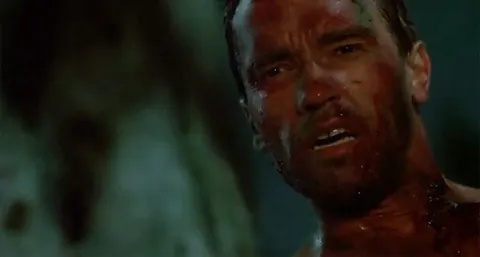
In the 1987 film Predator, Dutch, played by Arnold Schwarzenegger, meets Dillon, played by Carl Weathers. The friendly greeting turns into a display of strength: the men lock hands and for a moment seem to compete over who can pull the other over. The scene is remembered for its big muscles and the energy of the meeting, although for the plot it is above all the introduction of two men with a shared military past.
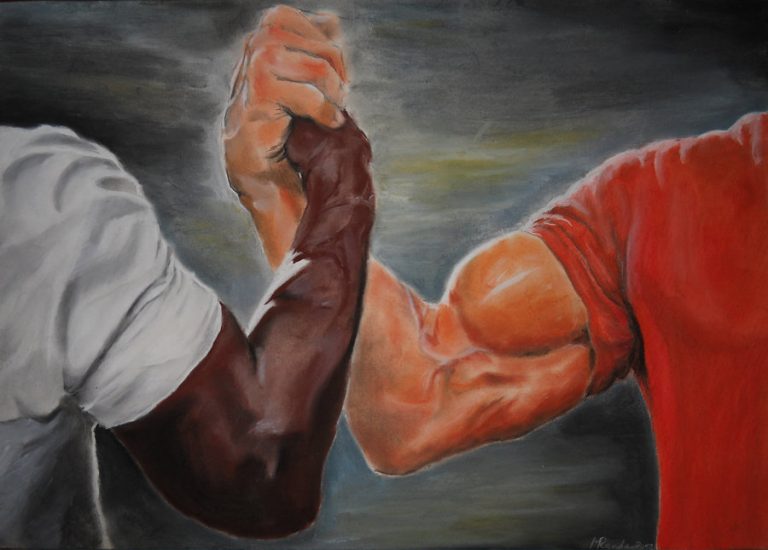
The clip from the film lived on in parodies and remixes long before the captioned pictures. In 2012, an artist under the nickname MILOSLAVvonRANDA published a drawing that kept the clasped hands as its main subject. It was this kind of reworking that became a convenient basis for a scheme with the names of two sides and a shared trait. A noticeable wave of these macros came in 2018. The scene, the drawing and the captioned template each have their own stage in the history; the film's year alone does not date the appearance of the meme format.
Two hands fill the frame
The drawing is set against a gray background. On the left is a dark muscular arm with a light sleeve; on the right, a lighter arm with a red sleeve. The hands are joined in the center, and the forearms form nearly symmetrical diagonals. There are no faces, sets, or text. This is already a highlighted artistic image, not a photographic still with actors.
Such reduction makes the picture resemble a clear diagram. Each side keeps its own color area, and the shared grip is clearly visible without explanation. In the usual version with captions, the eye first notes two different names, then moves to the center and discovers the unifying trait. The muscles give this small coincidence extraordinary importance, as if the participants had not simply agreed but concluded an alliance capable of changing the course of an entire story.
An alliance where a dispute was expected
The joke often starts with a contrast. The hands are labeled with groups that usually argue about tastes, habits, or ways of doing the same thing. The central caption suddenly reveals a match. It does not erase the differences but picks out the single point where both sides can support each other with equal enthusiasm.
Because of this, the format differs from a simple statement of “we are alike.” It has a small plot of reconciliation: two independent forces meet in one action. An overly heroic form amplifies the most down-to-earth reason, such as love of snacks or irritation at a long download. Sometimes the shared trait turns out to be unappealing, and then the handshake sounds like self-irony. People may solemnly unite not around an achievement but around the same procrastination, forgetfulness, or habit of hitting snooze.
Which coincidences turn into victory
In the invented version, the left hand is labeled “strategy game lovers,” the right “racing game lovers,” and the grip “a thirty-gigabyte update before a short evening game.” Genres divide players, but the wait for a download unites them more strongly than any debate. Another version sets people who get up early against those who go to bed late. Their common point is unexpectedly the same: the joy of a weekend when no one has scheduled a morning meeting.
One everyday example joins fans of sweets and lovers of salty food under the caption “finishing someone else's fries on the way home.” Here the viewer first expects a clash of tastes, then learns the exception to the rule. In each case the center matters more than the groups themselves: it explains why two strong hands met. Removing the shared trait would leave a striking picture, but the unexpected basis of the alliance, which is what makes it a meme, would disappear.