From a sneaker to any flat object
Among the early known traces of the format is a post by Joshua Garcia on Ultimate Guitar in October 2017. In it an ordinary sneaker was compared with an altered sole: the author jokingly demanded that the shoe reproduce the shape of the round Earth. Later similar images spread on Facebook, and in February 2018 versions with a computer mouse and a car appeared.
The occasion was an online polemic around the flat Earth. The parody imitated a naive question that sounds like a decisive refutation of science. Instead of a real measurement, it proposed looking at a familiar thing and drawing a huge conclusion. Changing the object expanded the series: shoes, electronics or vehicles received the same requirement of shape.
The skateboard belongs to this family of comparisons, but the author and date of this particular edit are not established. The history of the early sneaker explains the construction of the question rather than proving that the depicted board was the first variant. Each new example repeats the same leap between a small object and the whole planet.
A straight skateboard and a humped board
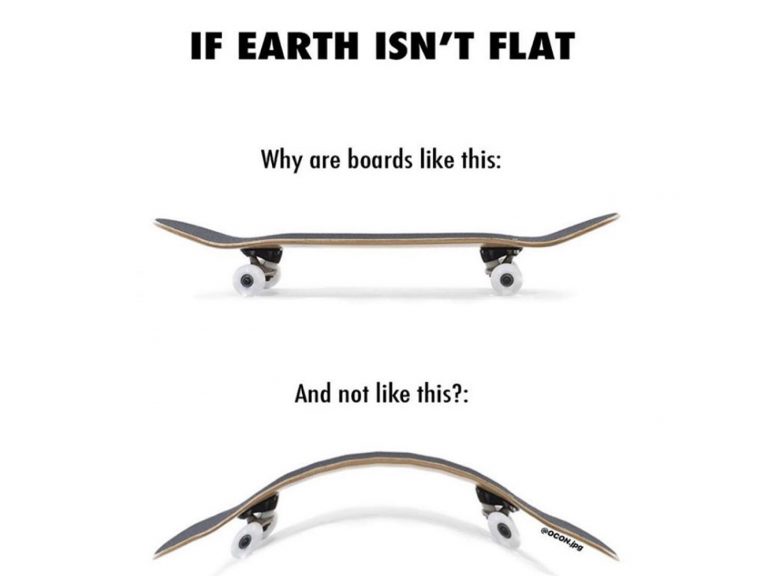
On a white background, the English condition “If the Earth isn't flat” is printed large at the top. Below, the question accompanies an ordinary skateboard: its middle is nearly straight, its ends are raised, and four wheels are visible under the board. The second line proposes comparing it with a reworked image in which the middle of the board is strongly raised into an arc and the edges point downward.
The lower variant looks as if the skateboard has to wrap around a small ball. The Earth itself is not shown in the picture: the viewer completes its shape from the proposed bend. The edit changes a familiar object without demonstrating any actual skateboard design. The two panels are built as a visual question with a prepared absurd answer.
Why the pseudo-proof looks convincing for a second
The joke mixes scales. The size of the Earth is measured in thousands of kilometers, while the length of a skateboard is a fraction of a meter. Over such a small stretch, the surface of the huge planet does not turn into a slope like the one in the lower picture. The edit makes the curvature deliberately large and invites the viewer to accept this exaggeration as a necessary consequence of sphericity.
An additional substitution concerns the purpose of the object. The board's shape depends on how one stands on it and performs tricks, not on any need to depict an entire globe. The question pretends that every object must have its own miniature model of the planet. That is why an ordinary skateboard is unexpectedly declared evidence of a cosmological theory.
The comedy appears when the viewer recognizes the error that the author of the question plays at with a serious face. The absurd bend intensifies this role: the photoshop looks like a visual teaching aid, but its clarity only highlights the faulty reasoning. The format allows the satire to be repeated with different objects while the false logical link stays the same.
Three new pieces of evidence for an invented debater
In an invented variant, an ordinary bench and its copy bent into an almost semicircle are shown. The question reads: “Why sit on this one if the Earth is round?” The author pretends that the comfort of a seat must follow the scale of the planet. The harder it is to imagine a person on the bottom bench, the more obvious the absurd demand becomes.
Another version compares a straight door mat with a mat curled around a globe. The caption declares the first one “suspiciously flat.” Here a household trifle gains the status of irrefutable evidence, though its job is to lie at the entrance. The familiar purpose of the object collides with a disproportionate conclusion.
The third example uses a desk ruler and a heavily curved modification. The question demands an explanation of why an ordinary ruler does not wrap around the Earth. The joke is especially pointed with a measuring instrument: an object made to help with precise measurement is used for deliberately faulty reasoning. All three scenes keep the look of a confident proof, but they demonstrate precisely the gap between the shape of a small thing and the structure of a planet.