The cartoon's plot
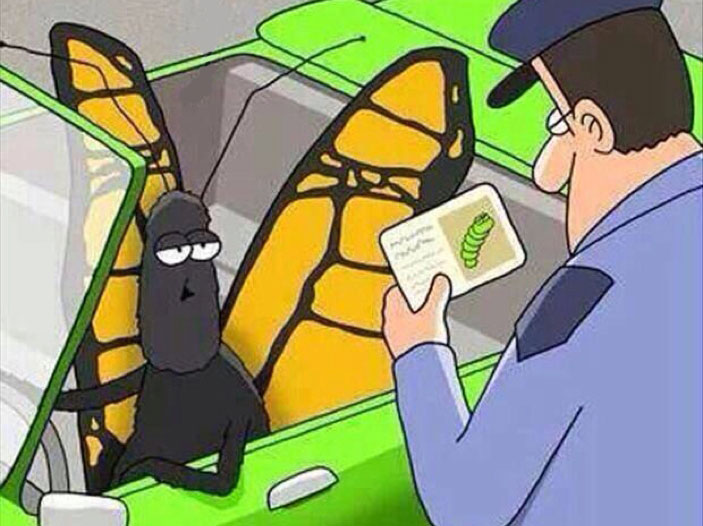
The center of the drawing is a green car, and a butterfly sits inside. Her wings are orange and black, her body is dark, and her expression is sleepy and displeased. Beside the car stands an inspector in a blue uniform and cap, holding a driver's license. A caterpillar is drawn on the document. The inspector seems to be comparing the photo with what is in front of him, and this is a visual joke: the butterfly was once a caterpillar.
The composition is simple. The car fills almost the whole frame, the inspector looks at the document, and the butterfly turns away. This style is typical of cartoons printed in humor collections and spread online without captions.
Origin
The cartoon dates to 2014. The author is not named, and the original publication has not been found. The drawing exists in several versions: the colors, the inspector's position, and the inscriptions differ. In some versions the butterfly's head was replaced with the head of a well-known person. Such variants are derivative editions rather than a separate original and should be marked separately.
Even the base drawing has no confirmed source, so who drew it and where it was first published can only be stated as a presumption.
The phrase and its meaning
The phrase “That's an old photo” works as an excuse. The butterfly seems to tell the inspector that the document is outdated and no longer reflects her current look. Hence the meme's core meaning: a person has changed so much that old photos no longer look like them. The meme is used when someone wants to show that a person has changed noticeably, such as by losing weight, changing their hairstyle, or simply looking different.
The comic effect comes from a literal reading. The inspector checks the document, and the document turns out to be a photo of a caterpillar, a creature at the very start of its transformation. The joke works at the level of the image and needs no explanation.
Caption examples
The meme is often used in chats and in discussions of appearance:
“You recognize a person by their documents? — That's an old photo.”
“A friend came to the meeting in a new jacket with a new haircut. — That's an old photo.”
Both examples rely on the contrast between the document and reality. The caption sets up the situation and the picture underlines the absurdity, so the meme transfers easily into different conversations.
Why the image works
The butterfly's metamorphosis is an easy analogy. The viewer sees the link between caterpillar and butterfly right away and needs no explanation. That is why the meme travels well to different situations, from jokes about age to reactions to sudden changes. A simple visual metaphor lets the cartoon be used without knowing its context.
Another reason for its staying power is the gentle tone. The butterfly looks more bewildered and lazy than angry, so the joke stays good-natured even when it concerns someone else's appearance.
Variants and use
The cartoon is remade and edited, with captions and car details changed. Versions with photos of celebrities spread as derivatives of the meme and differ from the original drawing. The catalog focuses mainly on the drawing itself, and derivatives are marked separately so that the original and its editions are not conflated.
The scheme “the document doesn't match the person” has long been familiar to users, so the cartoon quickly moved from one community to another. It appears in chats, under photos, and in discussions of how appearance changes over time, and each time the joke rests on the same image.