What is visible in the picture
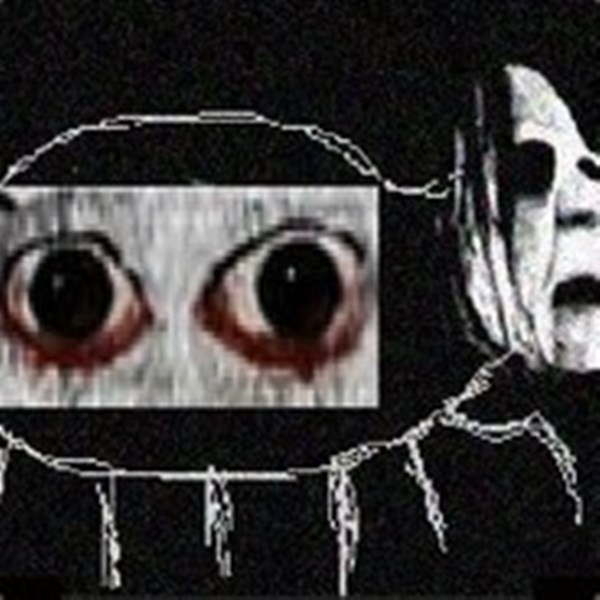
The image is dark, with a noisy grainy texture and low resolution. On the left, inside a rectangular window, are two large eyes with dark pupils and red streaks along the lower lids. The window is outlined with a thin white line, from which short white protrusions extend downward, resembling drips or fringe. On the right, a pale silhouette of a face in profile is visible, with dark strands of hair and a slightly open mouth.
The picture is almost monochrome: red appears only around the eyes. That is why the gaze goes straight to the center, where the two eyes look at the viewer. There is no recognizable portrait of a specific person in the frame; it is a stylized, eerie image.
An origin that is not established
The name of the format translates roughly as “eyes are crawling.” The picture is linked to 2019 and to VKontakte, but the first publication, the author, and the exact date are not established.
So the origin remains unknown. The format belongs to abstract and deliberately strange pictures that spread through communities with short captions, but any details about their creators would be speculation. For now this remains an open question.
While there are no sources, it is more reliable to rely on what is visible: a dark background, two intent eyes, and a sharp transition to a light face. These features describe the format more accurately than any legend about its creation.
Why such a picture works
The mechanics of an abstract meme rest on a sharp shift of expectation. The viewer sees a dark, almost frightening image, and the caption turns it into an everyday situation. The more serious the eyes, the funnier an ordinary phrase looks.
The black-and-white treatment and the red edges create unease, which the text immediately dispels. If the caption is dry and short, the joke works better than a long story.
This particular frame also has a technical side: the grainy texture and red edges stay unchanged, and only the caption changes. That is why the format is easy to transfer to any everyday scene — the eyes and the red rim already carry the right mood, and the text only needs to name the occasion.
Caption examples
“When on Monday it turned out the coffee had run out” — the emotion of the frame blows a trifle out of proportion, and the laughter comes from the mismatch of scales.
“Looked at the price in the store and remembered my salary” — the caption links the horror to a financial pause. The pause in the phrase works as a second frame.
“A friend said it was a quick question” — the caption reads as a warning, and the empty expectation turns an ordinary conversation into an ordeal.
“When someone in the chat writes “ok” and nothing else” — the meme describes a short reaction that seems ominous. The calmer the text, the stronger the contrast with the picture.
How to choose the source image
Take a picture with a pronounced gaze and a simple background. A close-up of the eyes works better than a full portrait: then the viewer sees only the emotion, and the caption does not compete with details.
Do not change the red areas too much: they create the anxiety. If you add text, place it on an even strip so it reads against the grainy background. Low resolution here is not a flaw but part of the style, so there is no point in trying to “improve” the picture.