What exactly appears on the card
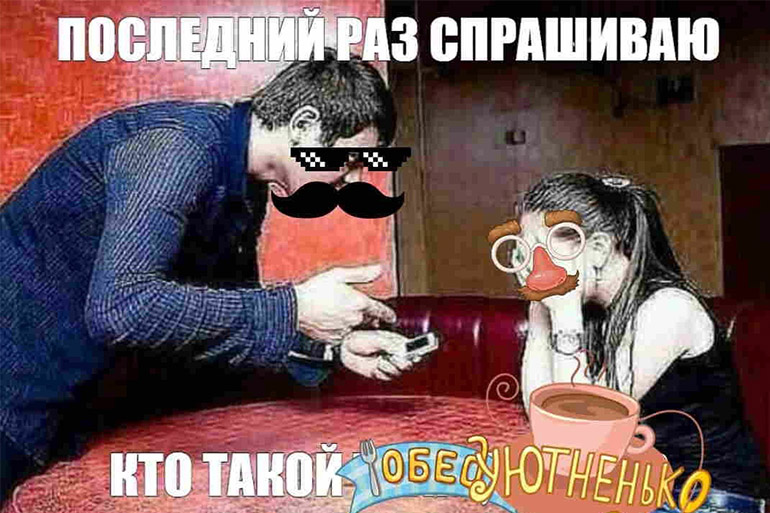
At the top of the image, in large letters: “Last time I’m asking.” Two stylized people sit across from each other; decorative stickers cover their faces, and at the bottom appears the question “who is obed uyutnenko.” This is not a literal depiction of a real interrogation or a documentary photo: it is a meme montage that joins a serious composition with a meaningless verbal repetition.
The stickers cover parts of the faces and distract attention from the dramatic pose. The combination of “obed” (lunch), “uyutnenko” (cozily) and absurdly attached decorations does not form a logical phrase. The more serious the original scene looks at first glance, the stronger the contrast with the deliberately incoherent styling. The entry describes one local variant, not all the pictures that used these stickers.
Where the sticker style came from
At the end of 2021, Russian-speaking users began placing stickers available in the VKontakte story editor over ready-made images. Among the notable elements were a mask with a nose, glasses and a mustache, and separate words: “obed” (lunch), “zavtrak” (breakfast) and “uyutnenko” (cozily). Early posts turned ordinary memes into overloaded and visually absurd collages.
By early 2022 this manner had become recognizable beyond the original community. The sticker was more than decoration: its deliberate use parodied the built-in design tools, while the meaningless words intentionally spoiled the original caption. The exact author of each variant is usually unknown, because pictures were forwarded, re-edited and given new elements. The history of the trend is better tied to an online format than to a single proven creator.
Post-irony and the breaking of meaning
A normal caption explains the image, but here the stickers prevent it from being read. A serious question about who is shown turns into the absurd “who is obed uyutnenko.” The added glasses and mustache visually alter the figures, and the words at the bottom give no unambiguous answer. The viewer simultaneously recognizes the familiar meme genre and sees that its rules are deliberately broken.
Such post-irony needs no deep hidden interpretation: the incoherence is part of the joke. People may laugh at stickers placed inappropriately and covering important areas of the picture. In other variants they cover the original caption completely, leaving only the repeated words. However, not every random overlay automatically becomes a meme; what matters here is the recognizable vocabulary of stickers and the repetition of one style.
How to make your own version
Take a neutral illustration with an expressive composition, add two or three stickers so that they interfere with the expected reading, and use a short caption such as “lunch? nice and cozy.” For example, the word “breakfast” can be placed over a solemn poster announcing a spaceship launch, and glasses with a mustache on the depicted device. The more noticeable the mismatch, the clearer the post-ironic tone.
Another safe option is to restyle an ordinary desktop screenshot: a “lunch” sticker covers the send button, and “cozily” captions a long queue of tabs. It is important not to cover text that contains a real warning or important information, and not to present the montage as the original picture. If a recognizable scene from a film or news story is used, the joke can be kept, but it should be noted that the stickers and words were added by the author.
The picture is not evidence
The picture includes a dramatized plot and heavily altered faces, so it cannot be used as proof of a specific event or to attribute these poses to real people. The exact source of the original scene is not established, and the characters are not named. In this format the origin is often lost, because editors combine templates and stickers from different publications.
The comic effect rests on visual conflict, but the original theme may be grim. When creating new versions it is better to choose fictional or neutral pictures rather than joke about real suffering. If the local composition resembles a heavy scene, the description may acknowledge that impression without inventing a specific story. This keeps the explanation useful: it shows what is funny in the sticker montage and honestly notes the limits of identification.