What the photo shows
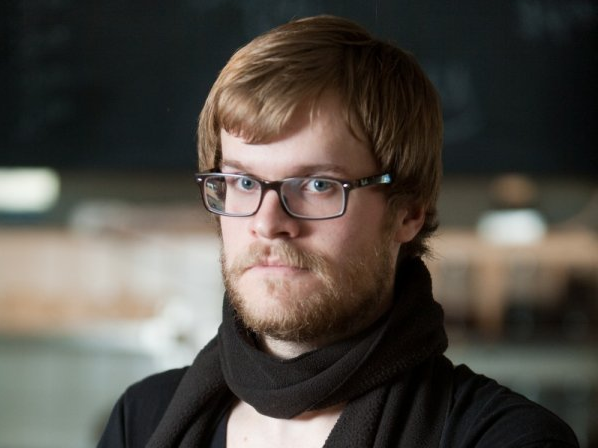
The shot is a portrait: the man looks straight into the camera, his lips are pressed together, his brows are slightly drawn, and his expression is serious and a bit displeased. He wears glasses with dark rectangular frames, a reddish beard, and a dark scarf wrapped around his neck. His clothes are black, and his light-brown hair falls over his forehead.
The background is blurred: a dark surface that looks like a board is faintly visible at the top, with light patches below. The photo itself shows no coffee cup and no counter. Everything that makes the subject a barista is added by the captions and context, and it is useful to separate what is visible from what the joke attributes to him.
A photo for a coffee shop website
The story does not start online. According to accounts, in the summer of 2011 a silly photo session with the coffee shop's staff was taking place. When someone asked for at least one serious shot, the man kept the scarf around his neck and tried to look as stern as possible. The picture became his profile photo on the venue's website and later turned into a meme, with its wide spread happening in 2011.
It is not known who first copied the photo and added white text in the macro style. There are also no indications that the joke was meant to mock a specific person. The “hipster barista” character is a fictional type built on a real photo, and it says little about what the man was actually like.
Why the serious pose became a stereotype
The humor lies in the gap between the pose and the expectation. The man looks as if he has been pulled away from an important conversation, while the caption says he works where coffee is served with a lecture on bean varieties. The viewer sees the scarf, the glasses, and the scowl, and already knows what the answer to a question about cappuccino will be.
The character gathers a set of traits that the internet attributes to “hipsters”: a deliberately independent air, an interest in the rare, and contempt for the mainstream. The photo gives that set a face, but on its own it reveals nothing about the man's character. That is why the meme reads as a joke about a type.
The mechanics are simple. The macro starts with a displeased face, and the text turns the displeasure into a principle. The seriousness of the frame makes an ordinary trifle a reason for argument, and this shift is what brings a smile.
Captions that work on contrast
Below are invented examples for this template.
“A flat white without milk is a principle, not a taste.” An everyday choice is raised to the level of conviction, and the angry face confirms that arguing is pointless.
“Don't know this band? It's not supposed to be known to you.” The phrase sounds like an excuse, but the tone of the frame turns it into mockery of the desire to be first. The quieter it is said, the louder the pride.
“Orders for six grades of beans are accepted only until nine in the morning.” A rule turns into a whim: the caption makes it clear the hero is certain he is right, and his eyes show it.
All the captions follow one pattern: the text assigns the hero a conviction, and the frame shows him defending it without a smile. A short line is stronger than a long one, because a serious face has no time for explanations.
How to use the template
The macro suits conversations about stereotypes within professions and about the trend of making everything “special.” It fits well in situations where a person turns a trifle into a principle and the people around them notice.
Keep the caption short. The seriousness of the frame already delivers half the joke, and any explanation weakens it. Names, place names, and recognizable details are best left out, so that the joke is about a type and not about the specific person in the photo.