From soundtrack to short edit
King's Dead was released on January 11, 2018. The track featured Jay Rock, Kendrick Lamar, Future, and James Blake; the song was part of a music project tied to the Marvel film Black Panther. The music video appeared on February 15 of the same year. Memes used a short part performed by Future, in which the narrator tells of meeting a girl and of his own uninhibited behavior. The recognizable rhythm and intonation made it possible to transfer this story onto entirely different characters.
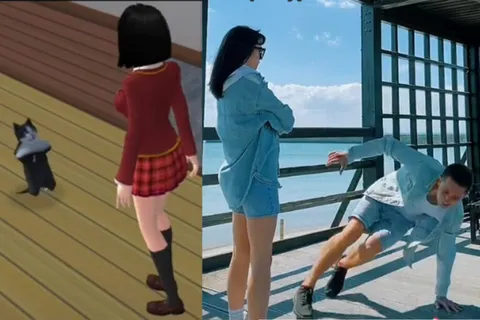
In March 2018 the fragment was used in a dance challenge, and in May parody edits built around it spread on Instagram and YouTube. One notable version paired the song with characters from the 2002 Scooby-Doo video game. The musical line became a pretext for showing an unexpected side of a familiar character. Such remixes did not necessarily retell the content of King's Dead: someone else's scene acquired a new meaning thanks to the moment the image switches. The Thanos version adds one more reference, topical for spring 2018, to this scheme.
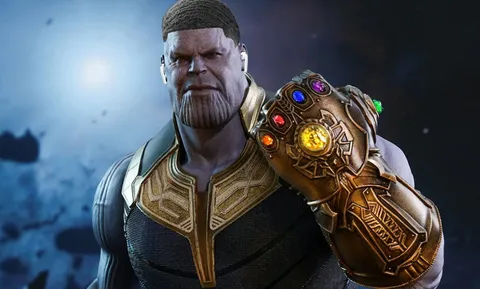
Two halves with different promises
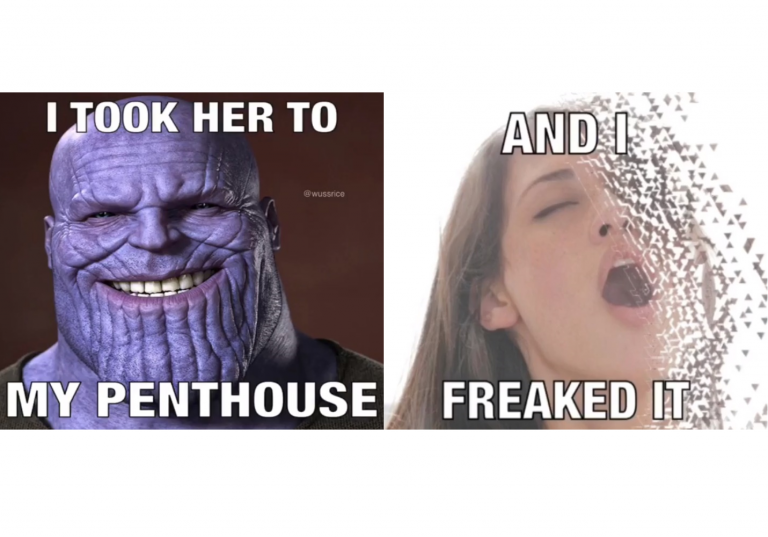
The large image of a smiling Thanos sits on the left. On the right is a woman with closed eyes and an open mouth; the right side of her face and the image break apart into small triangles. The English caption is split between the two halves, with wide white margins left around them. This is a composite picture, not a frame from the music video or a ready-made scene from the Marvel film. The woman's identity and the author of this particular edit are unknown. A small @wussrice mark on the left half preserves a trace of the image's circulation but does not by itself explain who made each part.
When the continuation changes the whole story
The first image promises a story about a self-satisfied character: Thanos smiles as if pleased with himself. The second initially supports the intimate undertone of the musical line, then breaks it with the disintegration effect. The viewer moves from an implied date to the villain's ability to destroy living beings. The result is a grim pun at the level of editing: a familiar boastfulness is suddenly read through the action of a fantastical villain rather than through a normal continuation of the song.
Overall, the format rests on two expectations. The character is recognized from the first frame, and the way he is transformed or behaves strangely is revealed in the second. The music sets the boundary between preparation and response. In the static version, that role falls to the split caption, which lets you reconstruct the reading order. To understand this particular edit, it is especially useful to know the ending of Avengers: Infinity War: without it the triangles look like a random effect, whereas a familiar viewer links the smile and the disappearance into one nasty joke.
Invented transitions to the same rhythm
In a made-up video edit, a stern librarian first closes the reading room, and on the musical cut appears in an enormous dinosaur costume at a dance contest. What surprises is the change of role, not a literal dating story. Another invented version shows a stern spaceship captain: the first part promises yet another order to the crew, and the second reveals his meticulously decorated dollhouse. The transition exposes a hobby that could not be guessed from the commanding image.
A third invented scene is built on the villain's self-satisfaction. He shows off a captured castle, then presses the wrong button, and his own fortress folds into a small cardboard box. Here a causal link remains between the two parts: the character takes pride in an acquisition and himself turns it into something absurd. Each such edit uses a short musical turn as the payoff of an independent story; the specific transformation matters more than a simple alternation of two random pictures.