What the picture shows
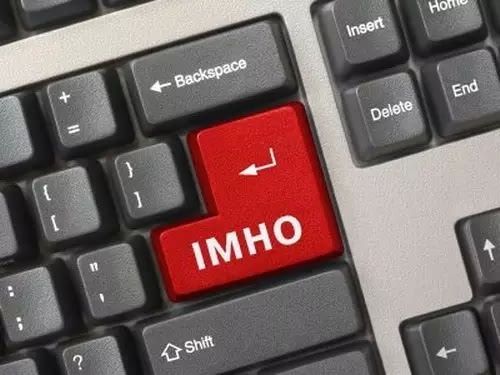
The photograph shows a gray-and-white keyboard in close-up. Almost all the keys are neutral: visible are "Backspace," "Insert," "Delete," "Home," "End," "Shift," punctuation marks, and symbols. Only one key stands out, red in color, matching the shape of the "Enter" key, on which a return arrow and the inscription "IMHO" are drawn. It is exactly this substitution that makes the image recognizable.
The image looks like a staged photo of a keyboard with an added red key. The author and the original file have not been established in open sources, so no further details about the picture's origin are given in the article.
Origin of the acronyms
Abbreviations like "IMHO" and "OMG" came from the English-speaking world. According to available information, such abbreviations were used in online communication long before mobile phones became widespread, including in mailing lists and on forums of the Usenet era. The best-known of them, such as IMHO and LOL, appeared there well before the 2000s, but they entered wide use only later.
The description of the material links the mass spread of the abbreviations to English-speaking users of the early 2000s, mostly schoolchildren. For them, acronyms became a way to convey emotion faster and more cheaply: in SMS and ICQ every character counted, and a short form allowed the meaning to be preserved. This is why many of the abbreviations survived even in offline speech.
The exact date of first use has not been established for every abbreviation. Many of them were passed around in small communities and chats, so the earliest instances are often hard to verify.
How the abbreviations are used
An acronym is placed at the beginning or end of a phrase to set the tone. "IMHO" precedes a personal opinion and emphasizes that the author is not claiming to be right. "OMG" expresses surprise or delight, while "LOL" denotes laughter or a light joke. In this way a short word replaces an entire construction and tells the listener how to interpret what was said.
In the Russian-speaking environment the abbreviations were adapted: "IMHO," "OMG," and "LOL" are written in Cyrillic, and some users invent their own analogues. This shows that internet slang quickly borrows English-language patterns and adapts them to local speech. At the same time, excessive use of acronyms is often mocked, especially when an abbreviation is placed where it is not needed.
A typical situation: a message in which every phrase ends with "LOL" or begins with "IMHO" provokes irony from the people reading it, because the habit turns into a reflex.
Why the joke works
The picture plays on the literal meaning. If "IMHO" really were a key on the keyboard, it would make sense to press it at the end of every message, like "Enter." The key is positioned exactly where a finger naturally rests before sending a message, so the joke relies on a familiar movement and brings a smile.
The comic effect arises from the contradiction between the serious meaning of the acronym and the mundane function of the key. "In my humble opinion" sounds like a polite qualifier, while the Enter key is a mechanical action. Combining these two meanings mocks the automatism with which users insert standard abbreviations into every message.
The image is also easily recognized because it relies on a familiar object. Everyone who has ever typed messages on a computer understands what is going on, even if they don't remember the exact meaning of every abbreviation. In this way a simple photograph turns into a clear and durable joke about the language of the internet.