what's in the picture
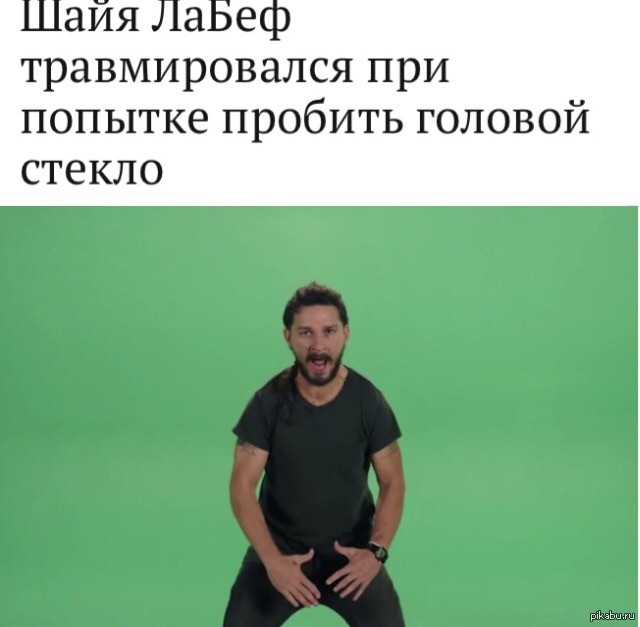
In the photo, Shia LaBeouf, wearing a dark T-shirt, stands against a green background in a half-crouch, hands pressed on his knees, mouth wide open as if shouting. His expression is tense and determined, his posture emphasizes the emotion, and the flat background strips away any context.
The top text is styled as a fake news headline. It reports an absurd, fictional injury, as if the actor had tried to headbutt through glass. The contrast between the serious framing of the headline and the expressive pose is what creates the joke. The flat green background became a universal backdrop in which any caption looks equally convincing.
origin and history
The meme's source is the project "#Introductions," created in May 2015 by artists Shia LaBeouf, Nastja Säde Rönkkö, and Luke Turner together with students from Central Saint Martins in London. The students wrote short monologues, which LaBeouf performed in front of a green screen. The resulting 30-minute film was released under a Creative Commons license, meaning it could be freely remixed.
One of the segments, written by Joshua Parker, was an overly emotional motivational speech built around the call "Just Do It." The clip quickly spread online in late May and early June 2015, spawning numerous remixes and parodies. According to Google, it was the most searched-for GIF of that year.
The slogan "Just Do It" belongs to Nike, and the meme played on that association: the motivation in the video is delivered in an extremely over-the-top way with no commercial context at all. The video became one of the notable examples of how amateur remixes can turn source material into a meme in its own right.
how it's used
The meme is used as a call to action for someone putting off a task: "just do it." It's most often posted in response to complaints about laziness, fear, or indecision, for example before an exam, a date, or home repairs.
In another variant, the picture is captioned with absurd headlines about fictional incidents involving the actor, turning the serious tone into a parody. The format stays recognizable, so the caption can be changed almost endlessly while the background and pose stay the same. The meme has also become the basis for photos, GIFs, and short videos in which viewers repeat the pose and the shout, turning the call to action into a playful gesture. The irony is that the call itself sounds absolute, but contains no actual advice.
why the meme works
The video combines the serious tone of a motivational speaker with a completely ridiculous delivery. The green background strips the scene of any surroundings, and the repeated shouting turns the call into an almost literal instruction, which is what makes it funny.
The meme also triggers a kind of ironic self-recognition: many viewers see themselves in a person loudly demanding action while sitting in an awkward crouch. Thanks to its short format and clear message, the format has stayed relevant, and the phrase itself has already become part of everyday language. Because of how expressive the video is, it transfers easily into conversation: a single phrase is enough to recall the advice and get a smile. The absurdity doesn't cancel out how recognizable the rhythm is.