The meadow, Anakin and Padmé
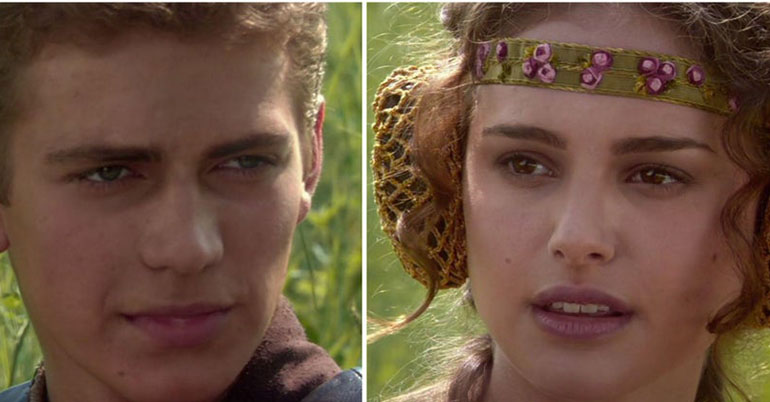
Two vertical images sit side by side. On the left is a young man with short light-brown hair, a scowl from under his brows and a barely visible smirk; the collar of his dark clothing fits tightly around his neck. On the right is a woman with brown eyes and a flower band in her hair, her hair styled in a woven net. Both stand against green grass, the light is soft and warm, and both faces are turned toward their conversation partner.
The actors in this scene are Hayden Christensen (Anakin) and Natalie Portman (Padmé). This pairing sets the emotional tone of the meme: she looks open and trusting, while he holds himself back and speaks with hidden meaning.
Which film and which moment
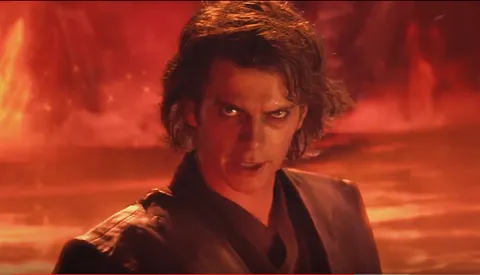
The frames come from Star Wars: Episode II – Attack of the Clones (2002), from the scene on Naboo where the characters discuss politics. This is a separate meme from an earlier joke based on Episode III, where the line “you did this yourself” appears: they have different scenes and different mechanisms.
The line “For the better, right?” itself does not appear in the film in this form. According to a fan encyclopedia, the dialogue was invented by users and only resembles a real exchange from that scene. As a format it has been circulating since 2021; the exact date of the first post could not be found.
How the joke is built
The template is usually shown as four frames: first Anakin announces that he will change the world, then Padmé hopefully asks “For the better, right?”, then he simply smiles, and she repeats the question, now anxiously. If a post keeps only two frames, the caption supplies this sequence.
The humor is not in the change itself but in what the viewer knows: Anakin will become Darth Vader, and the heroine is clinging to an illusion. That is why the joke spread far beyond fan circles: it is used wherever one person promises “improvements” and another already suspects how it will end.
Example captions
The captions were made up for this article. The character on the left is the one announcing change; the one on the right is the one who doubts.
Left: “I've decided to simplify the team's workflow.” Right: “It'll get faster, right?” The joke rests on the fact that any optimization usually ends up as new rules.
Left: “The new update redesigned the whole interface.” Right: “The buttons will stay where they are, right?” A familiar pain for anyone who has lived through a redesign.
Left: “I tidied up your desktop.” Right: “You didn't delete anything, right?” Here the question becomes the punchline: there is no answer, and the pause does the work instead of words.
Left: “I started saving money.” Right: “So there won't be any more spending, right?” The real answer is implied to be the opposite.
How to use it
The template works when a situation has two participants and one of them knows full well that nothing good awaits. One caption sounds confident and vague, the other a cautious question.
Do not make Anakin's line too villainous: the comedy lies in the ambiguity. It works better when his plans sound reasonable, and the catch is felt only in the pause between lines.