The lead-in from Let Them Talk
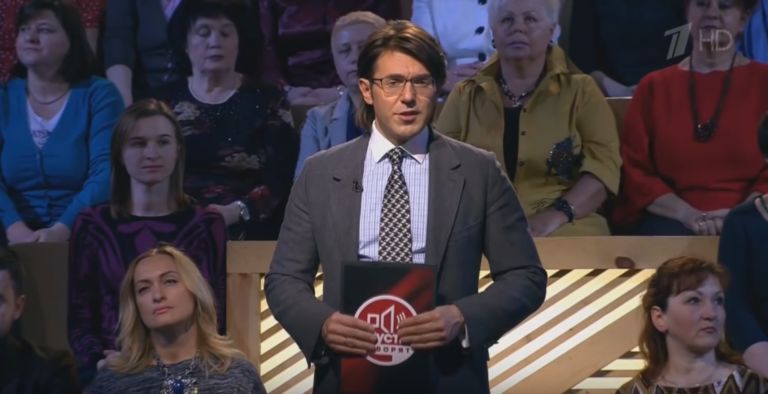
The phrase is connected with the talk show “Let Them Talk” (Pust’ Govoryat), which Andrey Malakhov hosted on Channel One. In the episode about an attack on a Muscovite woman, Oksana Muromets, the host introduced surveillance camera footage with a warning about the cruelty of what viewers were about to see and the indifference of those around. In the meme’s history this episode is dated to February 2, 2015. The words referred to a real, alarming story; the comic meaning appeared later, when the recording was re-edited and, after the lead-in, completely different footage began to be shown.
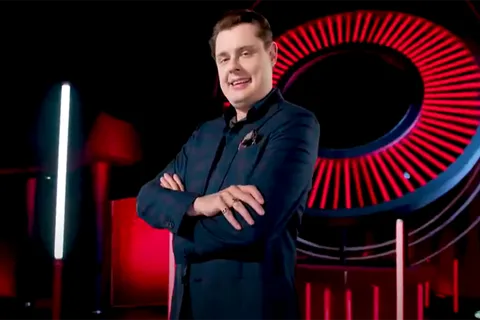
The studio shot has been preserved here: Malakhov in glasses, a gray suit and a tie stands before rows of spectators, holding a black-and-red folder. In the upper right is a “1 HD” mark. There is no added caption or the incident itself in the image. This is the face of a person about to present material, not a reaction to a funny clip already seen. This order is especially important for the video version: first anticipation is created, then the viewer is shown an unexpected continuation.
From a TV warning to a title card
The lead-in has a complete beginning that is easy to separate from the program. The address to the viewer promises that a transition is about to take place from a story to evidence: they will see the footage for themselves. Mention of two heavy concepts at once sets the tone in advance. When an ordinary failure appears instead of a dramatic plot, the serious promise stays in memory and makes what is happening disproportionately important. That is why the meme spread primarily in cuts and video mixes, although the phrase can also work as a caption for a single image.
The mechanics of an exaggerated warning
The author takes the most official voice possible and attaches it to material with a disproportionately small stake. The calmer and more solemn the host looks, the more noticeable the gap with the clip that follows. It is better to keep the caption short: it can call an ordinary action “footage,” and direct the word “indifference” at a person who did not turn off the kettle or forgot to reply in the chat. The word “indifference” is especially handy for a scene where everyone stays calm: nobody notices a slowly collapsing tower of cups or a cat’s victory over a roll of paper. The studio audience in the background adds an invented scale of public discussion.
Three invented continuations
Before a clip of a cat solemnly pulling a single sock off a table, the whole lead-in can be left unchanged. The viewer expects an incident and sees a tiny domestic theft. In another variant, after Malakhov’s words, a friend is shown neatly dividing the last pizza into unequal pieces. Here “cruelty” is aimed at a person who got only one crust, while the official voice inflates an ordinary dispute over dinner.
For a group chat, a recording where everyone diligently waves at a departing bus except a buddy calmly finishing a sandwich will do. The lead-in turns his imperturbability into the main event. In such an edit what is funny is the coincidence of the word “indifference” with visible behavior, rather than merely a loud formula placed before any random video. The pause between the warning and the continuation lets the serious tone settle; no extra explanation after the punchline is needed.